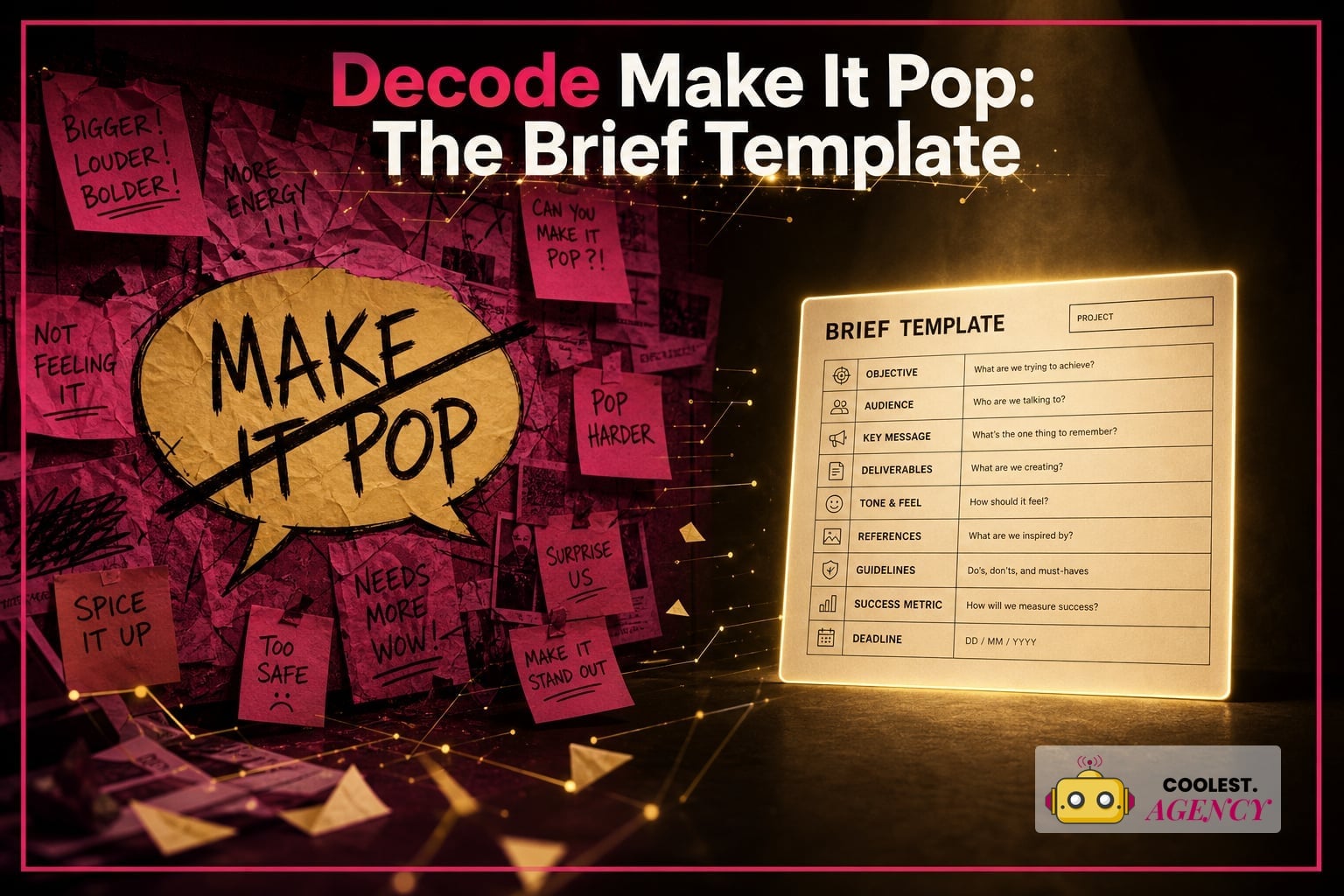
The Creative Brief Template That Finally Decodes "Make It Pop"
A creative brief template built for ambiguous feedback turns "make it pop" into a locked creative direction in one call, not five revision rounds. Every agency owner has heard it. Almost none have a system built to catch it. That gap costs you margin, and this fixes it.
Key Takeaways
- One structured feedback-to-brief session cuts revision rounds in half, because the client signs off on direction before anyone touches a pixel.
- "Make it pop" is a vocabulary gap, not a bad client. Five diagnostic questions surface the real ask in under three minutes.
- A locked brief needs four fields only: emotion, benchmark, keep, and success signal. Nothing else earns a place on the page.
- 49% of executives think their company acts well on feedback, but only 31% of employees agree, per Employee Feedback Loop, CultureMonkey, the same gap sinks client calls.
What 'Make It Pop' Actually Means (and the Questions That Crack It Open)
Clients say "make it pop" when they feel something missing but lack the vocabulary to name it. Five diagnostic questions pull the real ask out of them in under three minutes, no mind-reading required.
Here's the rebuttal to the agency instinct that "make it pop" means the client is being difficult: they're not. They're pattern-matching a feeling against a design vocabulary they never studied. Your job is translation, not telepathy. That's the creative control problem every agency hits with AI in miniature, vague human input, unclear machine output, nobody happy.
Ask these five on the call: What should someone feel in the first two seconds? What competitor or brand does this well? What's the one thing we cannot lose? Where does the eye go first? What would make you say "yes" out loud? Each question maps to a specific creative lever, contrast, hierarchy, tone, pacing. Skip them, and you're guessing. Guessing is expensive. As every marketer's intuition sharpens over years of client calls, per the marketer intuition that no AI quality check can replace, the same instinct that catches AI slop also catches vague feedback before it becomes wasted work. That intuition, paired with why your AI content sounds like everyone else's and how to fix it, is your Unfair Advantage on the call, not after it.
How to Structure a Creative Brief Template Around Vague Feedback
A creative brief template built for ambiguous feedback has four locked fields: the emotion the work should trigger, a reference benchmark, one thing to keep, and one measurable success signal. Fill those four boxes and the guesswork ends.
Only 31% of workers believe their company acts well on the feedback it receives, against 49% of executives who believe it does, per CultureMonkey's Employee Feedback Loop report. That gap between "feedback given" and "feedback acted on" is exactly what a locked brief closes, for clients, not just teams.