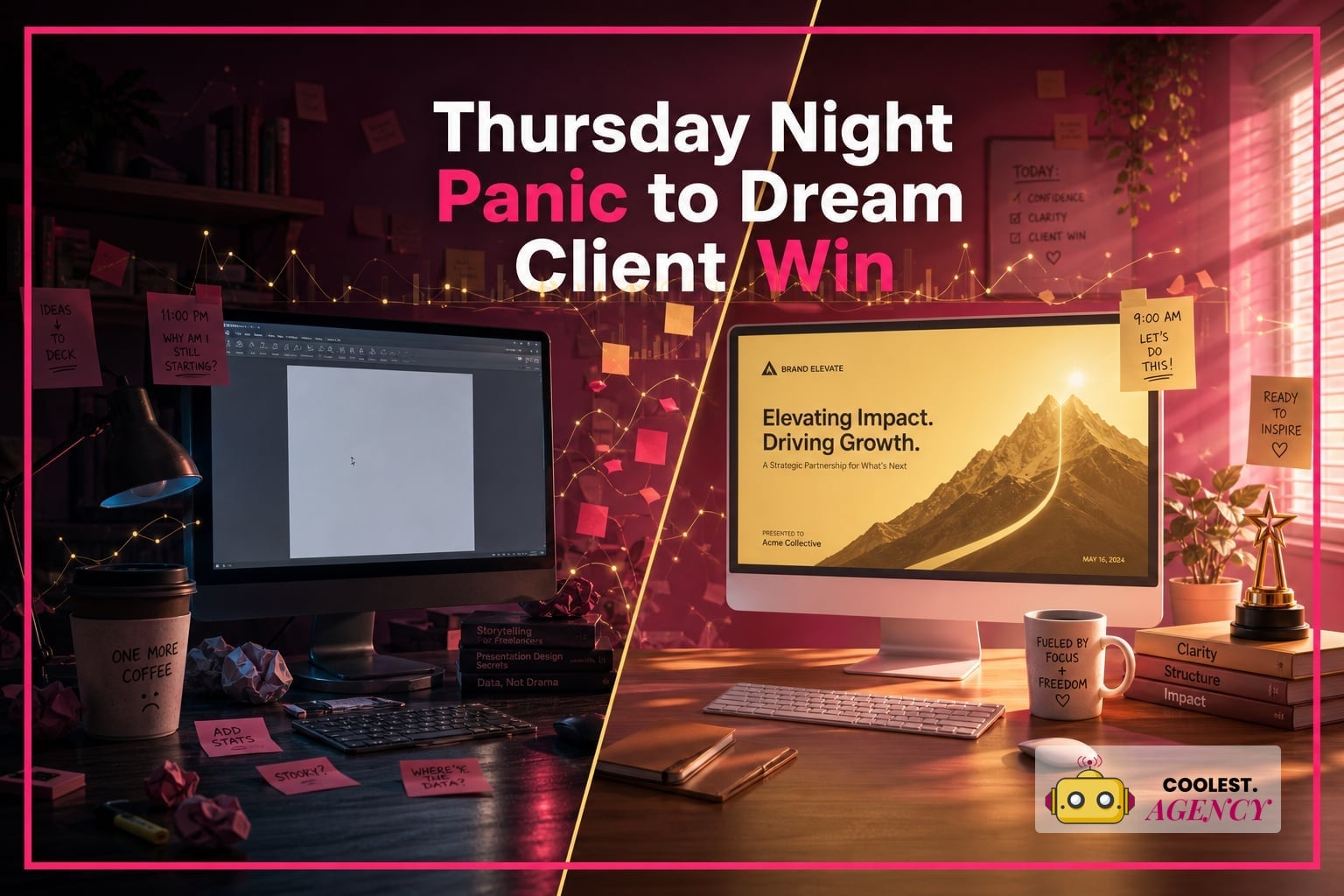
The Thursday Night Panic That Turned Into a Dream Client by Friday Morning
Here's the freelancer AI case study nobody else is telling you: a solo social manager got a high-stakes RFP at 11 PM Thursday, had zero staff, and submitted a polished, strategy-led pitch by 9 AM Friday. No agency. No all-nighter. Just a strategic reasoning engine doing the heavy lifting while she kept the voice human.
Key Takeaways
- Freelancers using AI earn 25% to 47% higher income than non-AI users, per AI Impact on Freelancing Statistics 2026.
- AI-assisted freelancers finish projects 25% to 40% faster on average, the same report finds.
- A generic prompt gives you words. A strategic reasoning layer gives you a pitch that sells.
- You can replicate this exact win in three steps, in one evening, starting tonight.
What Really Happened the Night Strategy Beat the Clock
The overnight pitch is a real freelancer scenario: an RFP lands Thursday night, and by Friday morning a full content strategy and visual mockup is ready to send. That's not a fantasy. That's what happens when speed stops being the bottleneck and strategy takes the wheel.
She opened the RFP at 11 PM. Blank doc. No deck. No sleep in sight. Instead of freelancing solo through five hours of brainstorming, she briefed a strategic reasoning engine with the client's industry, audience, and voice.
By 2 AM, she had a positioning angle no competitor pitch would touch. By 7 AM, visuals. By 9 AM, the deck was in the client's inbox, and it read like a week of agency work.
This mirrors what's documented in the human-in-the-loop workflow that tripled engagement, where human judgment plus AI speed beat either one alone. It's also the exact arc covered in founders who turned blank-page panic into real revenue. Panic to proposal, one night, real money on the other side.
Why the Generic Prompt Lost and the Strategic Engine Won the Room
Generic AI predicts the next average word from average internet content; a strategic reasoning engine is trained on high-conversion marketing patterns, so it writes pitches that sound sharp, human, and built to close. Clients feel that gap even when they can't name it.
Here's the contrast. Generic AI output: safe adjectives, no angle, sounds like every other pitch in the inbox. Strategic reasoning output: a specific hook, a client-world reference, a reason to say yes tonight.