← Back to blog
human-in-the-loop creative workflowAI content audit processAI editing best practicestiered AI content reviewfact-checking AI outputs

The Human Oversight Workflow That Makes AI Drafts Sound Like You: Audit, Draft, Edit, Optimize

E

· 18 October 2026 · 4 min read

The Human Oversight Workflow That Makes AI Drafts Sound Like You: Audit, Draft, Edit, Optimize

The Human Oversight Workflow That Makes AI Drafts Sound Like You: Audit, Draft, Edit, Optimize

Your AI drafts read clean, and one of them just invented a statistic. Human oversight AI workflows fix this by putting a director at four checkpoints: Audit, Draft, Edit, Optimize. Over 70% of marketers have already lived through an AI brand incident, per the IAB figure reported by Profiles. Most oversight fails on capacity, not talent.

Key Takeaways

  • Over 70% of marketers have suffered an AI-related brand incident, so a signature step is not a safeguard.
  • Match review depth to content risk: a press release gets a human brand manager, a caption does not.
  • Draft in small pieces, not one giant article, to cut hallucinations.
  • Design the review screen for tired eyes: highlighted claims, visible context, approve or reject.
  • Your proprietary data, client stories and sharp opinions are the premium. Log why every edit happened.

How Do You Build an AI Workflow With a Human Director at Every Step?

Architect four checkpoints: Audit, Draft, Edit, Optimize. AI handles volume at each one, while you hold intent, approval and veto power, so no draft ships without a human decision.

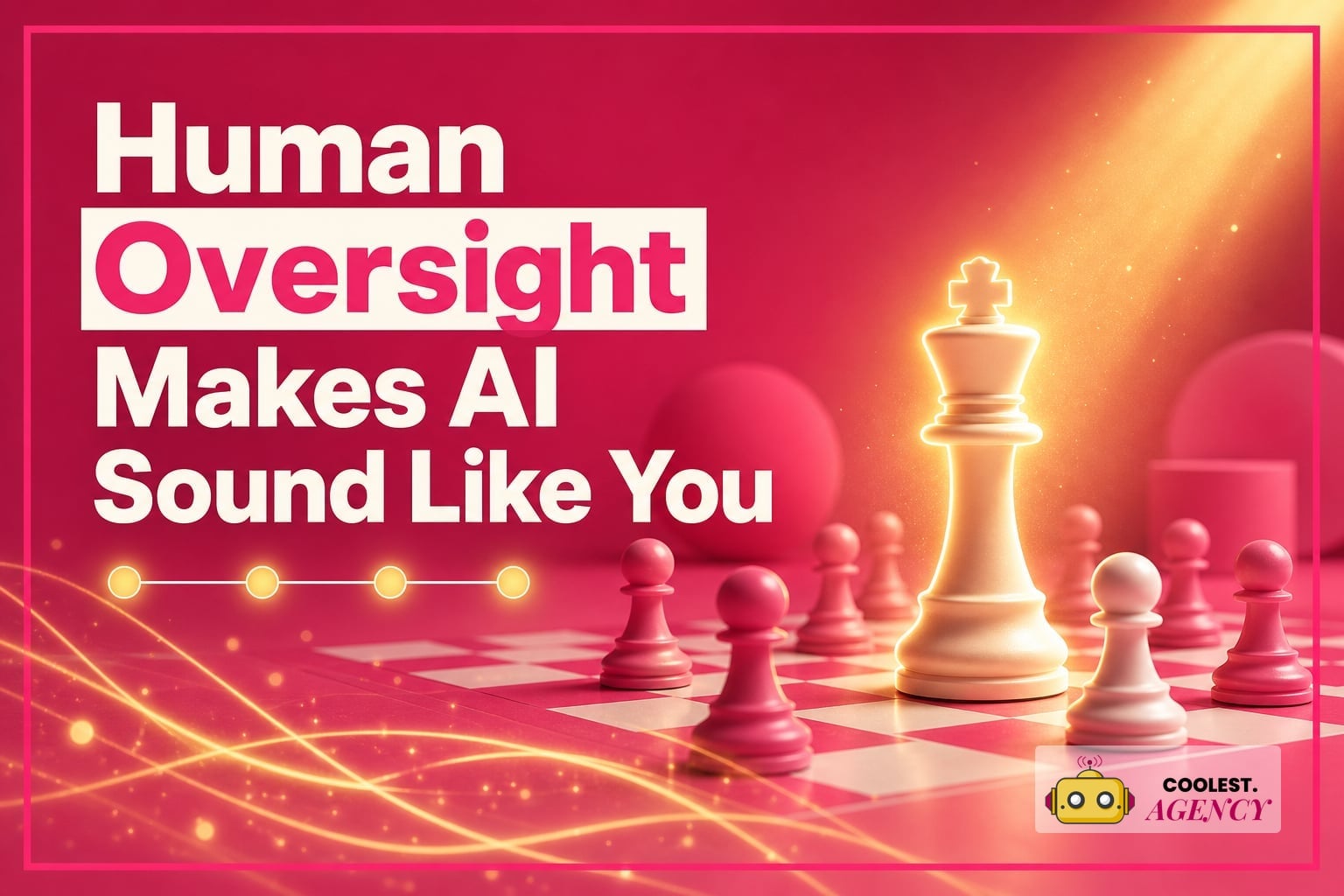
Picture a Grandmaster at a simultaneous exhibition. Twenty boards, one mind. The pieces move fast, but every move answers to a plan. Your AI is the board of pieces. You are not the one pushing pawns.

This is the centaur logic: AI brings speed, scale and pattern recognition, you bring intuition, nuance and ethics. Audit sets the rules. Draft produces raw material. Edit is where judgment lives. Optimize adds authority and measures the result.

A how small teams choose an AI content workflow comparison shows the same pattern: the teams that win assign a human to every handoff.

Step One and Two: What Should You Audit Before AI Writes a Single Draft?

Audit your brand boundaries, risk tier and source facts first. Then draft in small pieces (headlines, outlines, single paragraphs) rather than one massive article, which reduces hallucinations.

The contrast is brutal. Amateurs prompt for 2,000 words and hope. Operators hand the model a playbook: off-limits topics, banned phrases, verified facts. Our AI content audit framework starts the same way, with what the model may not touch.

Then tier your review by risk:

  • High: press releases and thought leadership. A human brand manager checks accuracy, cultural nuance and tone.
  • Medium: blog posts. An editor verifies every claim.
  • Low: routine social copy. Spot checks.

The stakes are real. In MIT Sloan's review of hallucinations, 790 of 863 court decisions on fabricated filings landed in 2025 alone. The Mata v. Avianca lawyer trusted citations that never existed.

Automate your entire content operation

Generate, publish, and track a month of posts on autopilot.

Start Free →

Is Human Oversight Still Possible When Reviewers Get Tired?

Yes, if you design for it. Reviewers shown clear context, highlighted claims and simple approve or reject options avoid automation complacency, where tired humans wave through plausible mistakes.

Here is the uncomfortable number: 35% of workers say they rarely or only occasionally review AI output before using it. Another report ties 68% of AI failures to inadequate human review (a 2023 Gartner survey, as cited by Resumly).

So what does a sharp reviewer need? A LinkedIn post on AI review names four conditions: time, context, authority and consequence. If the queue is 200 items and the hour is short, you have a clicking exercise.

Build the screen around that. Highlight every statistic and name. Show the source beside it. Offer two buttons. Calibrate trust too: over-trust waves errors through, under-trust bins good drafts.

Step Four: Where Do Expertise and Experience Signals Get Injected?

Your editors add what models lack: proprietary data, real client anecdotes and a defensible opinion. These E-E-A-T signals, plus logged edit reasons, make each draft better than the last.

The rebuttal to "AI will flatten everything" is simple. It flattens only what you do not touch. A model has never sat in your client's board meeting. You have. That is what clients are actually paying for.

Inject the signals by hand: your numbers, your named stories, your take. Disclose AI assistance plainly. Then log why each edit happened. After a month, those logs become your prompt rules. Measure outcomes, not word counts.

Handle client feedback in AI workflows the same way: log it, learn from it, feed it back. We were built by operators for operators, per our about page, and this loop is the one habit that separates the pros.

Pick one piece of AI-drafted content from this week, tag its risk tier, and mark every claim a human must verify before it ships. You will see exactly where your oversight is thin.

Ready to put your marketing on autopilot?

Join teams that ship more content in a week than most do in a month.

Get Started Free →

Automate your content

Start Free →

We use essential cookies to run Coolest.Agency and, with your permission, analytics and advertising cookies to improve it and measure our campaigns. Learn more.