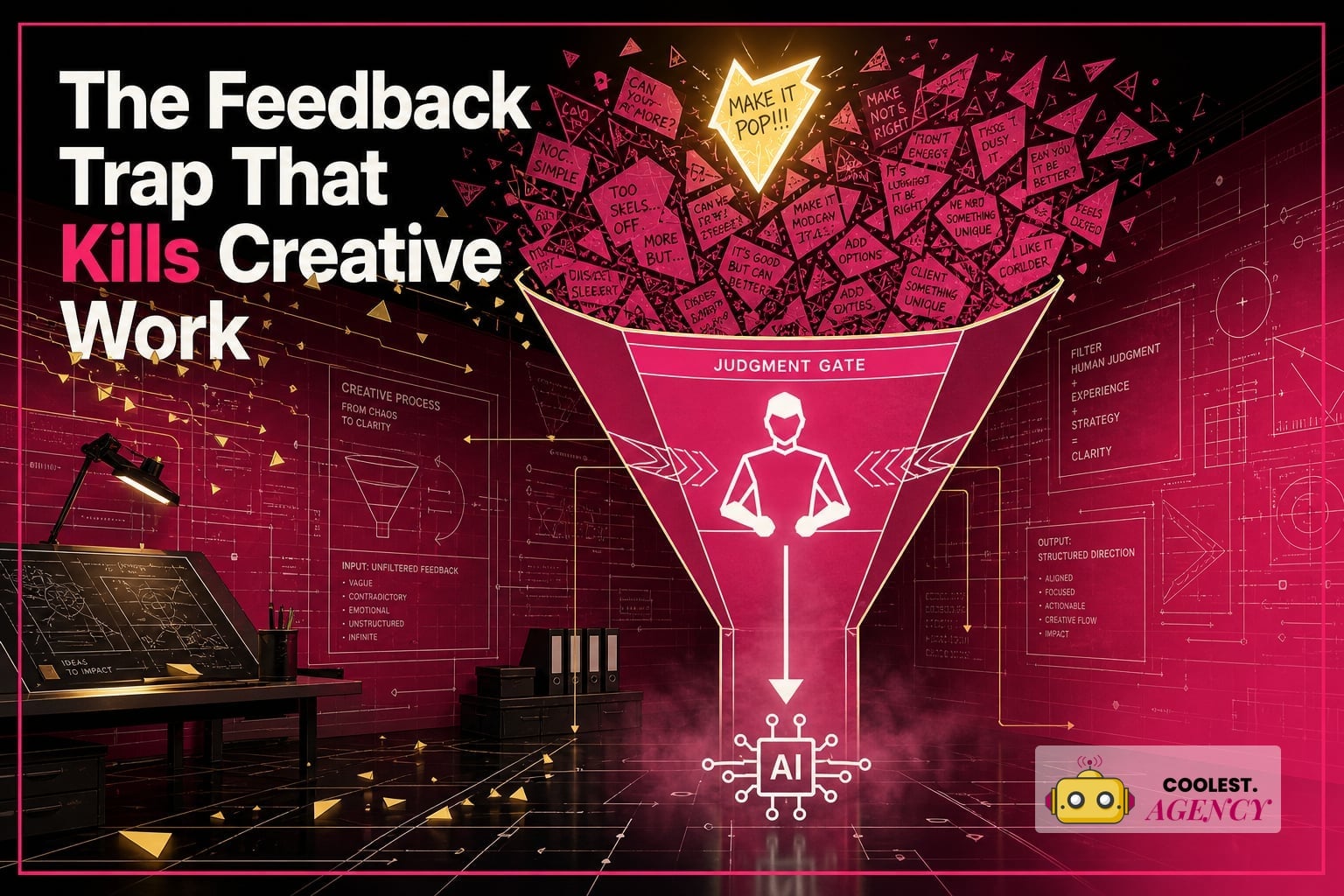
The Client Feedback Trap That Kills Creative Work (and How Agencies Beat It with AI)
Client feedback kills creativity faster in an AI workflow than it ever did in a human one, and that's not a hot take, it's a design flaw. One vague comment, "make it pop", gets typed straight into a prompt, and the machine obeys instantly, no pushback, no gut check. The fix isn't better clients. It's a filter between their words and your AI.
Key Takeaways
- 72% of marketers say a culture of measurement is already killing creativity, per a LinkedIn study of 250 marketing decision-makers, AI just speeds up the damage.
- A translation layer that turns "make it pop" into concrete creative parameters stops contradictory feedback before it ever reaches your prompt window.
- A human review gate between feedback and re-generation protects creative intent at the strategy level, not the prompt level, cutting wasted revision rounds.
- 64% of executive teams have stopped backing pure brand-building work, per the same LinkedIn-cited study, proof that this fight predates AI and will outlast it.
Why Client Feedback Breaks AI Workflows Faster Than It Breaks Human Ones
AI models have no ego, no instinct, and no memory of the original creative brief. Every vague comment rewrites the rules from scratch, and errors a tired human editor would quietly filter out get baked straight into the next draft, compounding with each round.
Here's the number that should worry you: 72% of marketers already believe a culture of measurement is killing creativity, according to a LinkedIn-published study of 250 in-house marketing decision-makers. That was before AI entered the chat.
A human copywriter reads "make it pop" and quietly asks, "pop compared to what, the last campaign, the client's mood, the competitor's launch?" An AI reads it as a literal command and torches your typography, your tone, your whole visual system in one pass. No hesitation. No memory of why the brief said "restrained" three weeks ago.
This isn't a bad-client problem. It's a workflow design flaw. Feed raw feedback straight into a generation tool and you've built a system with zero institutional memory, which is exactly the creative control problem every marketer has with AI.
How to Handle Contradictory Client Feedback Without Torching the Relationship
When a client says "make it pop" and "keep it professional" in the same email, more prompting won't save you. What saves you is a translation layer that converts subjective language into concrete creative parameters before AI ever touches it.
Automate your entire content operation
Generate, publish, and track a month of posts on autopilot.
Start Free →
Compare what actually happens when raw feedback meets a machine versus a trained eye:
| Feedback Type | What the Client Means | What the AI Hears |
|---|
| "Make it pop" | Add energy without breaking brand tone | Maximize contrast, saturation, size, now |
| "Keep it professional" | Don't scare off the board | Strip color, shrink type, flatten voice |
| "This feels off" | One specific element bothers me | Rewrite everything from scratch |
| "Can we try something bolder?" | Test one bold variant, keep the safe one | Replace the whole concept immediately |
Every row in that table is a translation failure, not a client failure. Your job is to sit in the gap: ask which element bothers them, name the tradeoff between "pop" and "professional," and turn the answer into a written parameter before it becomes a prompt. That single habit is the difference between one clean revision and five confused ones, and it's the same instinct covered in the conversation that wins clients over on your AI workflow.
The Human-in-the-Loop Layer That Keeps Creative Control in Your Corner
Agencies that insert a human review gate between client feedback and AI re-generation cut wasted revision rounds because creative intent stays locked at the strategy level, not the prompt level. Nobody re-prompts on impulse; someone decides on purpose.
Picture this: a client emails "loved the concept, hate the colors" at 11 p.m. Without a gate, that note hits the AI raw by morning and you get a full re-generation, colors, layout, copy, all of it, because the model can't tell "colors" from "everything." With a gate, a human reads it, isolates the palette, and sends one targeted instruction.
That's the Audit-Draft-Edit-Optimize loop in practice: audit the raw comment, draft a translated brief, edit with human judgment, optimize the AI output against the original intent, never the other way around. It mirrors the discipline behind the four-step workflow that makes AI content actually brand-safe and the marketer intuition no AI quality check can replace.
Enterprises are deploying AI agents faster than governance programs can keep pace, and a misconfigured agent doesn't make one bad decision and stop, it repeats the same bad decision at scale until someone catches it.
That's the whole argument in one line: the gap between raw feedback and AI output is where creative work either survives or dies. Want to see what a human-first AI workflow actually looks like in practice? Explore how agencies are keeping creative control without slowing down output.