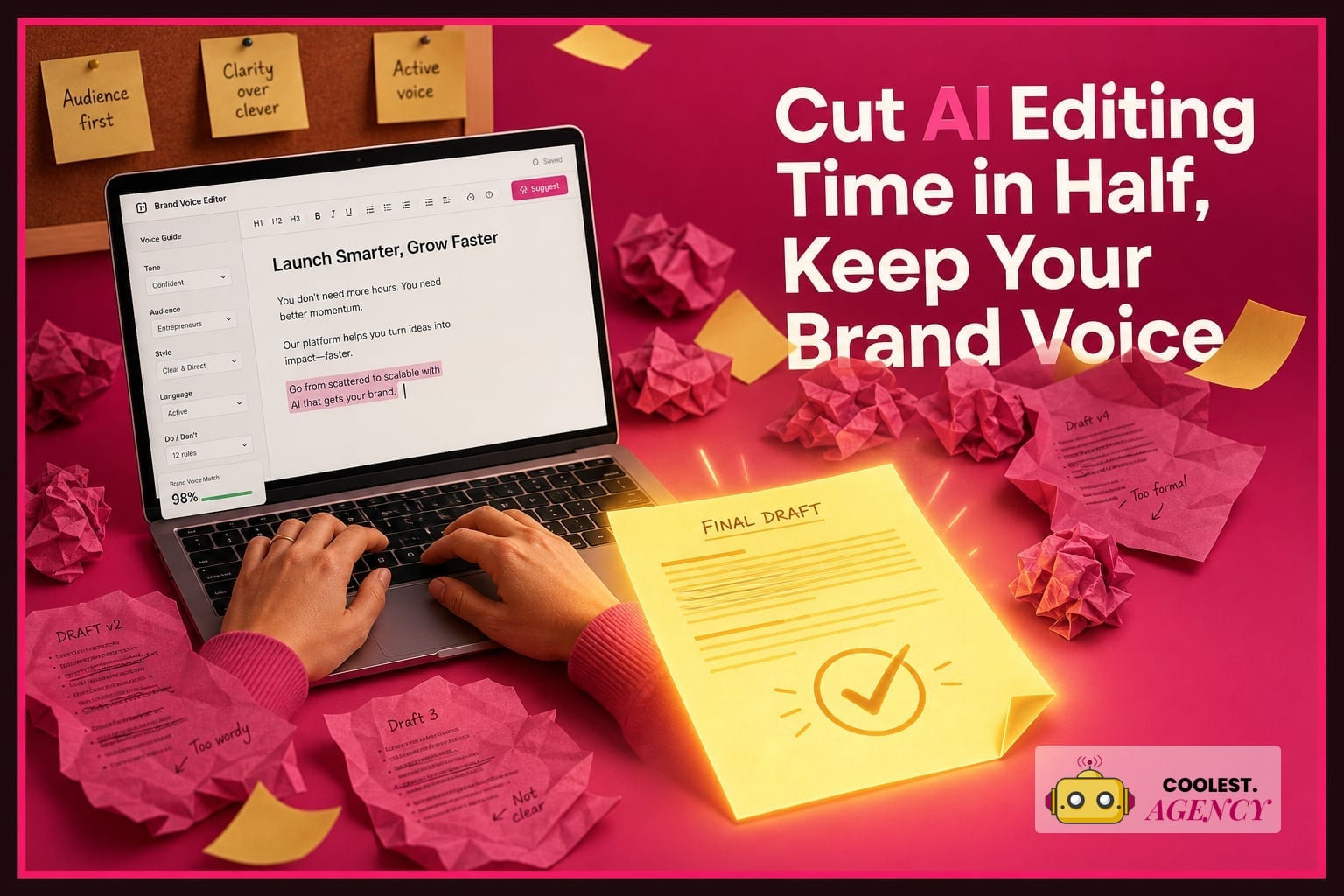
Cut Your AI Content Editing Time in Half Without Losing Your Brand Voice
Here's the trap nobody warns you about: AI drafts fast, then you spend an hour untangling why it sounds like a stranger wrote it. These AI content editing tips fix the actual bottleneck, which isn't the AI. It's your review process. Teams using structured checkpoints see 40-60% faster approval cycles, per Glean's 2024 workflow research.
Key Takeaways
- 40-60% faster approvals happen when you split criteria checks from judgment calls, not when you read faster, according to Glean.
- Revision rounds drop from 5-7 to 2-3 once you front-load brand rules instead of patching voice issues at the finish line.
- Only 23% of marketers with documented brand voice guides actually feed them to their AI tools, per the Content Marketing Institute's 2024 report, leaving easy time savings on the table.
- Triage beats top-to-bottom reading. Flag risk first, skim the rest.
Why Your Review Cycles Are Dragging On Longer Than They Should
Most editors lose time because they review AI drafts the same way they review human drafts: linearly, top to bottom, with no triage system. You are hunting for problems instead of checking against a list.
Picture this: it's 4:45 PM, you've got three drafts left, and you're re-reading paragraph one for the third time because something "feels off." That feeling is expensive. You're doing unstructured judgment work when 60-80% of what you check is actually rule-based pattern matching, per TeamBench's 2026 review time study.
There's a second problem hiding in there too: automation complacency. When reviewers get tired, they start rubber-stamping AI output instead of catching real mistakes. Fewer than a third of organizations using AI report consistently good output, which tells you tired eyes are missing a lot. The red flags that reveal AI slop before it wrecks your credibility almost always slip through during this exact fatigue window, not during the first pass.
Fixing this isn't about reading faster. It's about restructuring what gets your attention and when, which is exactly what a Human-in-the-Loop workflow that makes AI content worth publishing is built to do.
The Four-Stage Cycle That Actually Fixes the Bottleneck
A four-stage Audit-Draft-Edit-Optimize cycle assigns AI and human effort to the right tasks, cutting redundant passes without dropping quality. Here's the contrast that matters: old workflows make you re-check everything, every time. This one doesn't.
| Old editing workflow | HITL-optimized workflow |
|---|---|
| Read whole draft linearly, 30-60 min per piece | Audit brief first, catch drift before drafting |
| Re-check tone, facts, structure all at once | Draft against a pre-set rule layer, AI self-checks tone |
| 3-4 revision rounds, high cognitive load | Edit only flagged sections, 1-2 rounds |
| Optimize as an afterthought, if at all | Optimize is its own tiered step, scaled to risk |
Audit means you set intent and boundaries before a single word gets drafted. Draft is AI's job entirely, structured in chunks, not one massive pass. Edit is where you apply judgment, not proofreading. Optimize is tiered: a quick social caption gets a light check, a press release gets full human validation.