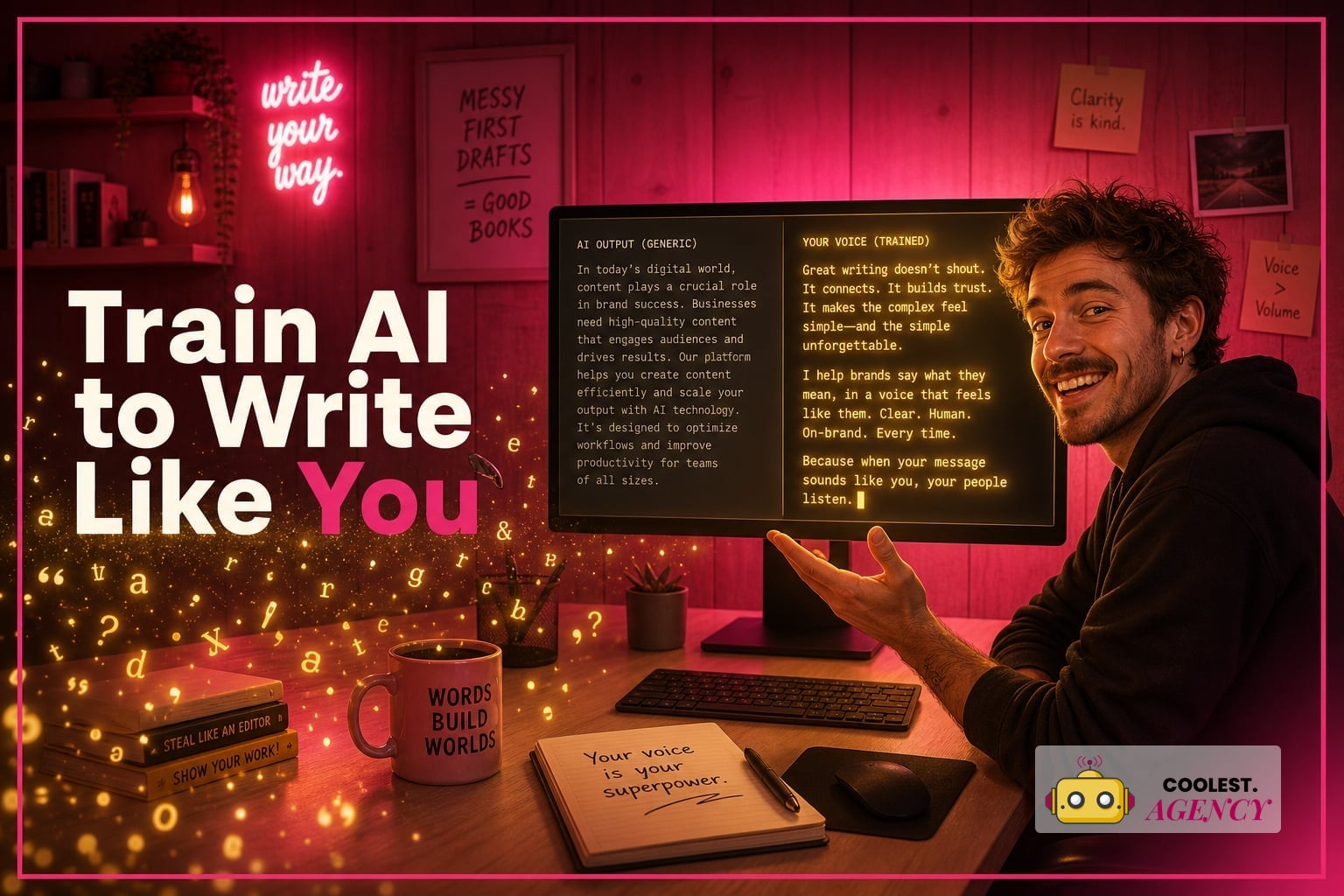
Why Your AI Sounds Like a Stranger, and How to Train It to Write Like You
Most guides tell you to feed AI a few sample paragraphs and call it done. That is why your outputs still sound like a corporate newsletter. If you want to train AI to write like me, you need a system with three layers, not one clever prompt.
Key Takeaways
- One prompt fixes one draft. A Digital DNA stack fixes every draft after it, permanently.
- 92% of businesses already use AI personalization to drive growth, per Algolia's 2024 report, but most skip voice entirely.
- Three layers beat one prompt: persona document, boundary playbook, style sample library.
- A human validation pass turns a one-time fix into a system that compounds.
Why AI Keeps Defaulting to Generic, and What Actually Fixes It
Your voice is a fingerprint. AI is trained to predict the statistical average of the internet, which means every output trends toward the mean until you architect a system that pulls it back to you.
Here is the contrast nobody tells you: better prompts make the average sound smoother, not more like you. Fast-growing companies drive 40% more revenue from personalization than slower ones, according to IBM's 2024 report on AI personalization, and voice is personalization's most neglected layer.
Your prompt is a paintbrush. It cannot invent the painting. The brand voice calibration method exists because prompting alone plateaus fast.
Architecting a reference structure is your Unfair Advantage, not a smarter instruction. That structure is what separates freelancers who sound replaceable from ones who sound unmistakable.
Architect Your Digital DNA: The Three-Layer Stack That Replaces One-Off Prompts
A Digital DNA stack is three linked documents: a brand persona file, a content boundary playbook, and a style sample library, together giving AI a living voice instead of a single instruction.
Picture this: you're a freelancer with three clients, three tones, one AI. Without a stack, every draft is a coin flip. With one, every draft starts from the same trained baseline.
Layer one, the persona document, defines traits, humor thresholds, and logic gates, the way Old Spice built a suave, silly voice instead of generic grooming copy. Layer two is your forbidden-words list and tone boundaries. Layer three is five to ten real samples the AI studies before it writes a word.