← Back to blog

Why Using Generic AI Tools is a Losing Strategy for Creators in 2026

E

· 21 May 2026 · 5 min read

Why Using Generic AI Tools is a Losing Strategy for Creators in 2026

Why generic AI tools are a losing strategy for creators in 2026

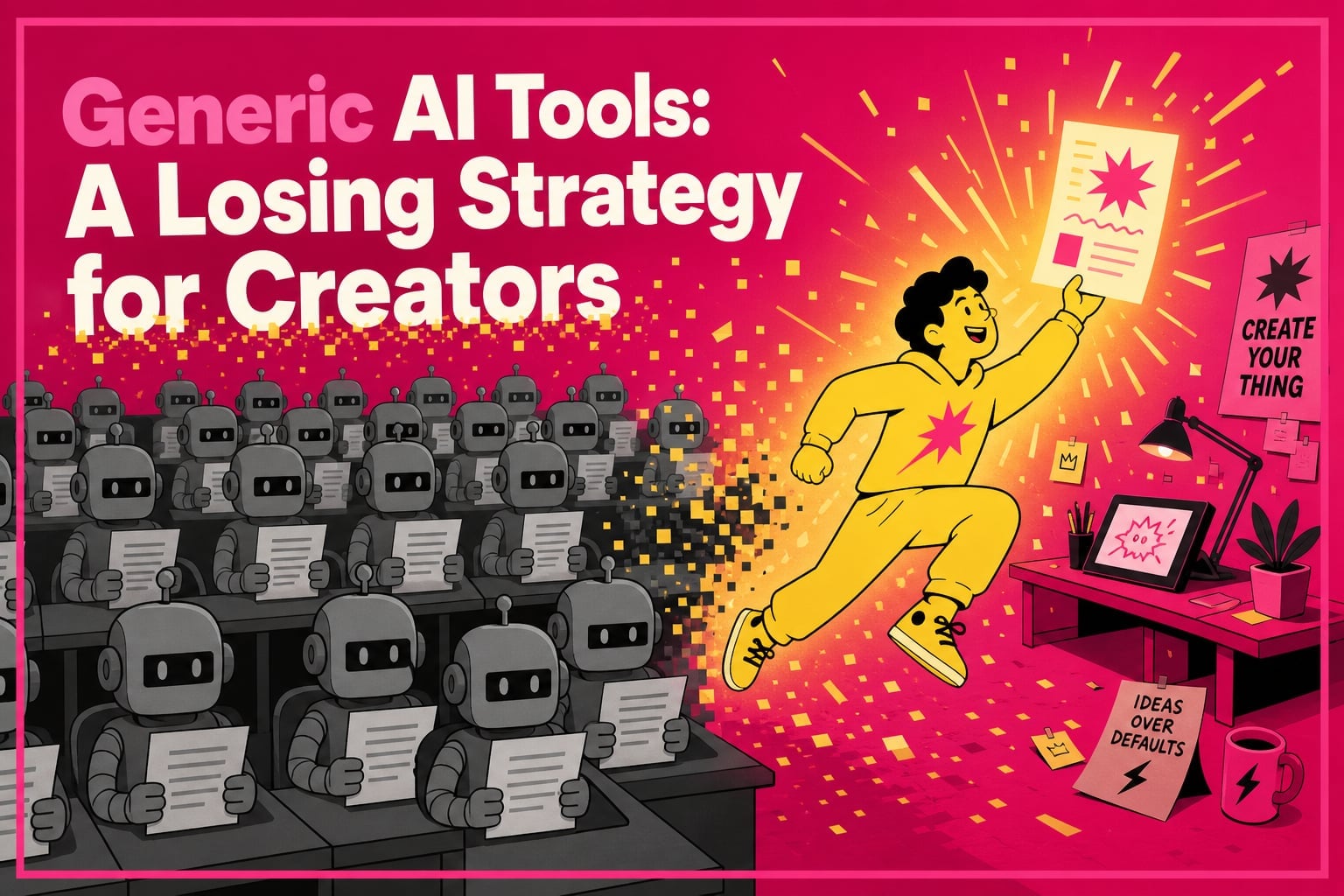
Here is the uncomfortable truth nobody in the AI hype machine wants to say out loud: using the same generic AI tools as everyone else does not make you more productive. It makes you invisible. When your output looks like your competitor's output, which looks like their competitor's output, you are not creating content. You are generating noise.

Key Takeaways

  • Generic AI tools produce generic results. In a saturated market, sameness kills revenue.
  • AI API costs dropped 60-80% in 2026, making access cheap and differentiation the only real moat.
  • Creator burnout is not caused by overwork. It is caused by doing high-volume, low-impact work.
  • Strategic, narrative-driven AI that learns your brand breaks the race to the bottom.
  • The post-generic AI era rewards specificity, voice, and positioning, not output volume.

How Did We Get Here? The Rise and Fallout of generic AI tools

Generic AI tools are general-purpose platforms trained on broad internet data to produce average, statistically likely outputs for any user who types a prompt.

In 2023, knowing how to use one was a competitive advantage. In 2026, that advantage is gone. GenAI adoption reached 16.3% of the world's population in H2 2025, and the number keeps climbing. The tool you use is no longer the differentiator. How you use it, and what it knows about you, is.

The problem is structural. Tools like ChatGPT are trained to predict the next most likely word based on the average of everything on the internet. Useful for drafting a grocery list. Terrible for building a brand people remember.

Most creators figured this out the hard way. They fed a prompt in, got something polished and forgettable, published it, and wondered why engagement flatlined. The content was not bad. It was just identical to everything else. According to Forbes Business Council, creators' actual pain points, including voice consistency and audience connection, remain chronically underserved by the tools marketed to them.

The AI bandwagon did not fail creators by being too slow. It failed them by being too average, by design.

What Happens When Everyone Uses the Same generic AI tools? The Pricing War and Burnout Trap

The AI content pricing war is the inevitable outcome when creators use identical tools and flood the market with identical outputs: clients stop paying premium rates because they can get the same result anywhere for less.

Frontier model API costs dropped 60-80% between early 2025 and April 2026. Access to AI is now essentially free. Which means the output of AI is essentially a commodity. Volume without differentiation just accelerates the race to the bottom.

Automate your entire content operation

Generate, publish, and track a month of posts on autopilot.

Start Free

The winning tool is rarely the cheapest. It is the one that proves indispensable. If you are discounting defensively against a cheaper competitor, you may be giving away margin you never needed to give.

Martin Casado, General Partner at Andreessen Horowitz, writing in Andreessen Horowitz, April 2026

The burnout piece is where it gets personal. Forbes reported in May 2026 that AI tools and IP fears are fueling exhaustion across creative industries. The irony: creators adopted AI to reduce workload, then found themselves doing more work to make AI outputs sound human. A creator spending two hours editing ChatGPT outputs daily is clocking ten hours a week on remedial cleanup. That is a part-time job in itself. Not a workflow. A punishment.

How Strategic AI Helps Creators Win in the Post-generic AI era

Strategic AI is a category of tools built around a specific brand's voice, positioning, and audience rather than around average internet output. The distinction is everything.

Take independent newsletter creator Lena Chu, who documented switching from a generic AI writing tool to a brand-trained AI workflow in early 2026. Within six weeks, her open rates climbed from 28% to 41% and she cut her editing time in half. Her explanation: the tool stopped sounding like the internet and started sounding like her. Audience trust followed.

IDC concluded in April 2026 that the real competition in AI is not over lowest-cost intelligence. It is over who can deliver trusted, measurable outcomes. For creators, that outcome is simple: content that builds an audience and commands rates generic output never could.

Only 7% of companies have fully scaled AI across their enterprise, per Master of Code's 2026 data. The other 93% are still experimenting. That is your window. The best strategic AI tools let you set your strategy once, then automate the repeatable work, freeing you to focus on creative decisions only you can make.

Your Next Move (Not a Vague Suggestion)

Audit one week of your published content. Ask honestly: could any other creator in your niche have published this exact content? If the answer is yes, your AI tool is working against you. Switch to one that actually learns your brand, this week, not next quarter.

Ready to put your marketing on autopilot?

Join teams that ship more content in a week than most do in a month.

Get Started Free

Automate your content

Start Free