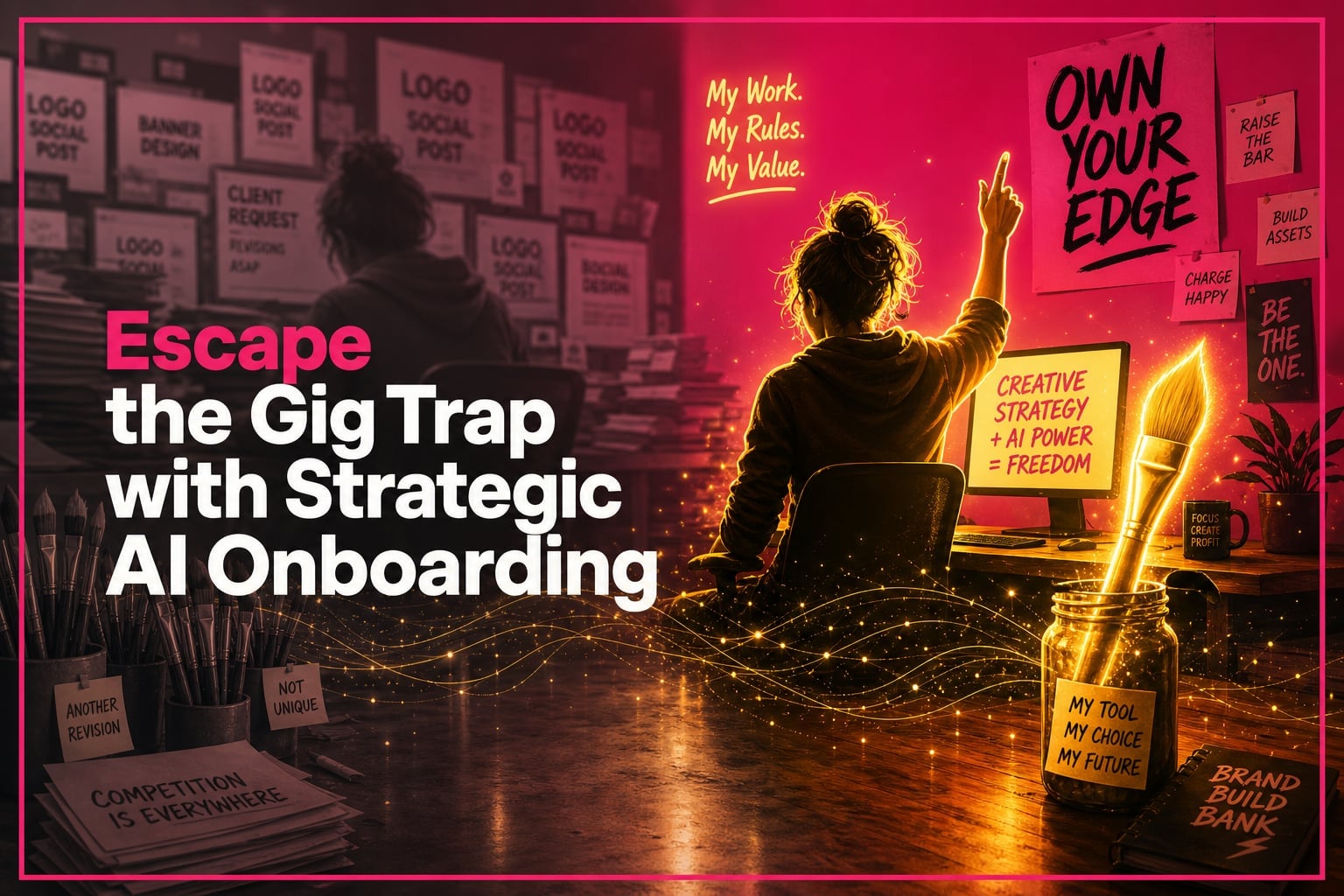
Why Strategic AI Onboarding Freelancers Must Embrace to Escape the Gig Economy Trap
Most AI advice for freelancers is about speed: generate faster, deliver more, charge less. That advice is a trap. The freelancers winning right now are not the fastest prompters. They are the ones who have taught their AI their voice, their logic, and their client standards before a single deliverable gets made. That is strategic AI onboarding, and it is the difference between a retainer and a race to the bottom.
Key Takeaways: How Strategic AI Onboarding Freelancers Stay Out of the Gig Economy Trap
Strategic AI onboarding for freelancers is the deliberate process of feeding your AI tools your brand voice, client standards, and creative boundaries so every output sounds like you, not the internet's average.
The gig economy is not shrinking. Rushford Business School reports that 57.3 million Americans freelance and 55% of gig workers earn less than $50,000 a year. More competition plus generic AI output equals one outcome: your rate goes down.
- Generic AI use accelerates commoditization. Strategic use reverses it.
- Brand personality injected at the onboarding stage protects your premium pricing.
- Clients pay retainers for consistency and trust, not just speed.
What Happens When Freelancers Skip Strategic AI Onboarding?
Skipping AI onboarding means letting your tools default to the internet's median output: safe, flat, and forgettable content that any client can replicate themselves for free.
The data is uncomfortable. A 2025 INFORMS study found that for every 1% increase in a freelancer's past earnings, they experience an additional 0.5% drop in job opportunities and a 1.7% decrease in monthly income after AI tools entered their market. Your track record is not protecting you. Your differentiation has to.
You are probably using AI like a faster keyboard. Here is why that costs you: clients can smell generic output. They have ChatGPT too. When your work looks like theirs, you lose the negotiation before it starts.
Surprisingly, top-performing freelancers are seeing the largest setbacks. Skilled workers who once relied on expertise and reputation now find themselves competing with AI-driven tools that perform tasks faster and cheaper.
Xiang Hui, Assistant Professor of Marketing, Washington University in St. Louis, published in INFORMS Organization Science, March 2025
How Human-First AI Onboarding Makes You Unforgettable (and Uncommoditizable)
Human-first AI onboarding is the practice of building a personality architecture into your AI workflow: hardcoded brand values, tone constraints, and audience-specific language patterns that make every output distinctly yours.
Think of it as giving your AI a job description before it writes a single word. Harvard Business Review (March 2026) recommends exactly this: give every AI agent a defined role and design it to address specific pain points. That is not a corporate HR tip. It is your freelance moat.
Automate your entire content operation
Generate, publish, and track a month of posts on autopilot.
Start Free →
Coolest.Agency's approach to this is worth noting: rather than treating AI as a generic content machine, their platform learns your brand and stays aligned to it across every social post and campaign. You set your marketing plan over a cup of coffee, then lean back while it executes with your voice intact.
Case Study: From Generic AI Output to Brand-Driven Retainers
A brand-driven retainer is a recurring client contract anchored in your unique creative identity, not just your output volume.
Consider what happens when you reverse-engineer the onboarding. Freelance writer Kaleigh Moore documented her structured client onboarding process on LinkedIn, covering intake surveys, scoped calls, and templated process emails. The result: clients received consistent, brand-aligned work from day one, reducing revision cycles and building the trust that converts one-off projects into retainers.
The unlock is not the template. It is feeding that same client intelligence into your AI before you write anything. Audience pain points, tone preferences, off-limits language: all of it becomes your AI's operating system, not just a notes doc you forget to check.
Your Playbook: Steps to Start Strategic AI Onboarding Freelancers Can Use Today
Strategic AI onboarding for freelancers starts with a one-time setup that makes every future project faster, sharper, and harder to replicate.
MindStudio reports that freelancers using AI tools save an average of eight hours per week, translating to $2,000 to $4,000 in additional monthly income. That gap only widens when your AI is onboarded to your brand standards.
Here is your four-step setup:
- Build your Digital DNA doc. Write down your brand voice, three words you never use, your best-performing headline style, and your ideal client's biggest fear. This is your AI's constitution.
- Create a client intake template. Capture audience profile, tone preferences, and project boundaries before any AI touches the brief. AI-powered onboarding playbooks can automate this intake and generate a tailored brief in minutes.
- Set hard content limits. Tell your AI what it cannot say: competitor names, off-brand adjectives, passive voice. Constraints produce better creative output, not worse.
- Run a synthetic review before sending. Prompt your AI to argue against your draft from your client's perspective. Fix what it finds before they do.
Coolest.Agency automates steps two and three at the social marketing layer, publishing brand-aligned content without you rebuilding context every session. That is the compounding advantage: your onboarding work pays out on every single deliverable.
Your next step: Open a blank doc right now and write your Digital DNA. Ten bullet points. Your voice, your limits, your client's language. Paste it into your AI tool before your next project. That single action separates you from every freelancer still prompting from scratch.