← Back to blog

Why Publishing More Content Won't Boost Your Personal Brand Visibility: The Smarter Way to Stand Out

E

· 29 May 2026 · 5 min read

Why Publishing More Content Won't Boost Your Personal Brand Visibility: The Smarter Way to Stand Out

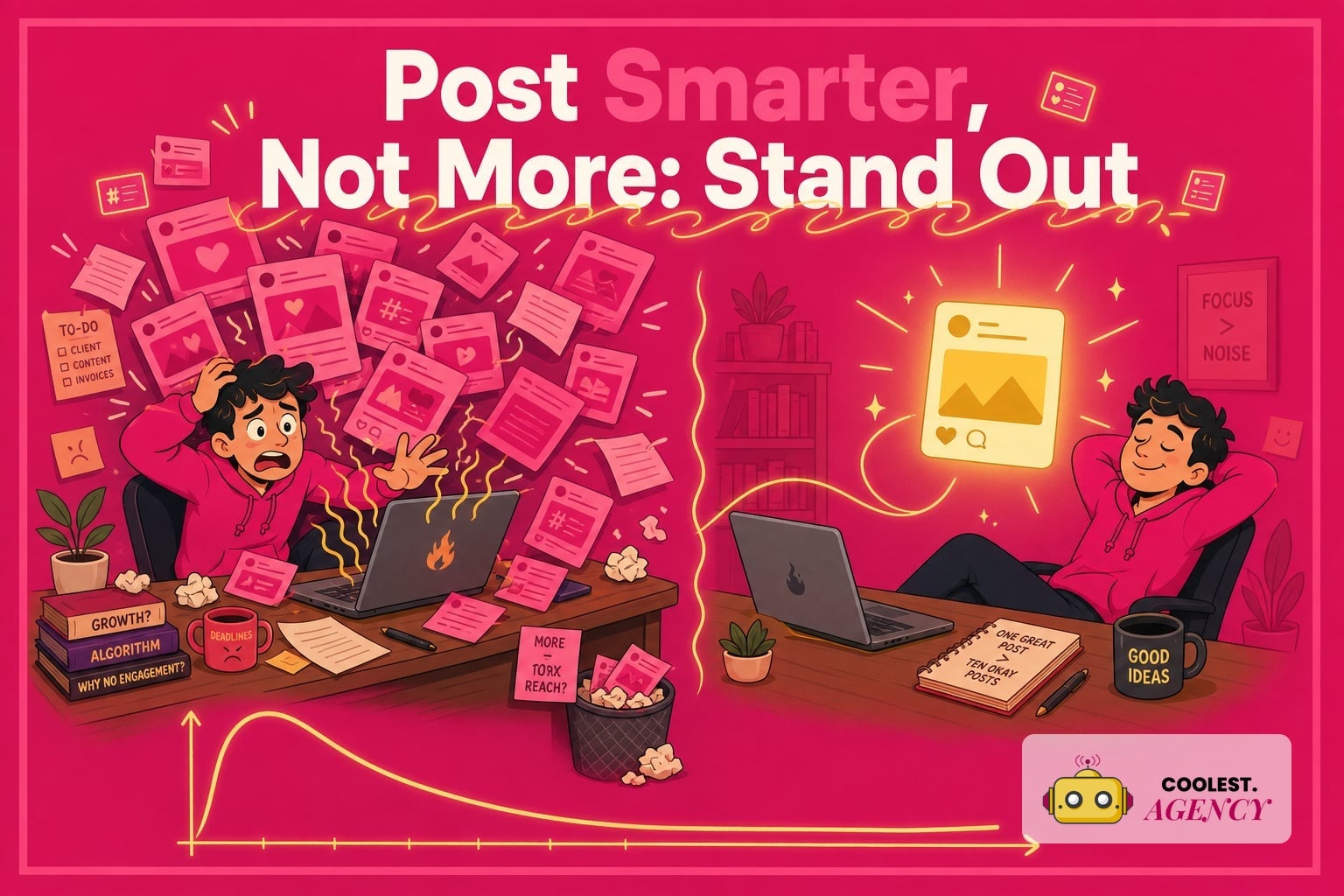
Content Velocity Myths: Why Publishing More Won't Boost Your Personal Brand Visibility

The content velocity myths you've been sold are costing you time, energy, and real audience growth. More posts do not equal more visibility for personal brands. The freelancers winning right now publish less, but they publish smarter. Here's the framework that actually works, and why the hamster wheel is a trap.

Key Takeaways

  • Publishing volume alone does not build personal brand visibility.
  • Diminishing returns kick in fast when content lacks a clear point of view.
  • One well-placed, deeply resonant piece outperforms ten forgettable posts.
  • Promotion and distribution matter more than production speed.
  • Smarter systems, not longer hours, are the real shortcut.

Why More Content Rarely Equals More Visibility: Busting Content Velocity Myths for Personal Brands

Personal brand visibility is the degree to which your target audience recognises, recalls, and trusts your name when they need what you offer. It sounds simple. It is not, and more posts will not fix it.

Here is the thing nobody in the "post every day" crowd wants to admit: your audience does not have a volume problem. They have an attention problem. Flooding their feed with mediocre content trains them to scroll past you, not stop for you.

According to Forbes, over 50% of searches now end without a single click. People are not consuming more, they are consuming more selectively. If your content is not the most useful, most specific, or most interesting thing in their feed, it is invisible regardless of how often you post.

The Velocity Partners brand awareness research puts it plainly: marketers have let major misconceptions about brand building calcify into accepted truths, and it is stifling creativity and results.

For freelancers especially, the cost is brutal. Every hour spent churning out a fifth LinkedIn post this week is an hour not spent on a single piece that could land a client, earn a feature, or shift how your whole industry sees you. Volume is not a strategy. It is a distraction wearing a strategy's coat.

To produce high-quality paid content, journalists need time and managerial support. Publish less, but publish better.

Sophie Casals, Editor, Nice-Matin, speaking to the Reuters Institute for the Study of Journalism

That quote is from journalism, but it lands just as hard for solo freelancers. Your audience is not waiting for your next post. They are waiting for the one post that actually changes something for them.

How Content Velocity Myths Hurt Freelancers and Creators, And What Actually Works

Content velocity, as a metric, measures how quickly you produce and distribute content over a set period. For enterprise brands with large teams, higher velocity can compound SEO authority. For a solo freelancer, it mostly compounds exhaustion.

Here is the contrarian truth: the velocity playbook was written for companies with content teams, not for one person trying to build a reputation. Hashmeta's analysis found that brands shifting from monthly to weekly publishing saw organic traffic increases of 47-63% within six months. But those were brands, not individual freelancers with finite hours and no editorial team.

Automate your entire content operation

Generate, publish, and track a month of posts on autopilot.

Start Free

When you apply enterprise velocity logic to a personal brand, you get content that sounds thin, rushed, and generic. That is the opposite of what builds trust. And trust is the only currency that actually converts followers into clients.

What actually works is a framework we call the Signal-to-Noise Ratio approach. Three moves:

  • One anchor piece per month. A long-form article, case study, or original take that earns real attention and can be cited or shared.
  • Three distribution posts per week. Repurposed fragments, reactions, and insights pulled from the anchor piece, not new ideas invented from scratch.
  • One relationship touchpoint per week. A direct reply, a comment, a collaboration pitch. Visibility is social, not just algorithmic.

Coolest.Agency's approach to content planning is built on exactly this logic: learn your brand voice deeply, automate the distribution layer, and free up your human energy for the thinking that actually matters. Set your social marketing plan over a cup of coffee, then lean back while the system handles the scheduling.

You are probably spending 80% of your time creating and 20% distributing. Flip that ratio and your existing content will work harder than any new post you could write today.

Real-World Strategies to Publish Less and Stand Out More, Without Falling for Content Velocity Myths

Publishing less and standing out more means replacing output-focused habits with impact-focused ones: fewer pieces, sharper angles, and deliberate distribution that puts your best work in front of the right people.

Start with a content audit. Look at your last 30 posts. Which three drove the most replies, shares, or inbound messages? Those three tell you your actual resonant topics. Stop guessing and double down on what already works.

Next, build a "pillar and splinter" system. One substantial piece becomes five smaller ones. A newsletter essay becomes three LinkedIn posts, one Twitter thread, and one short video script. Nelio Software's research frames it well: if you have six hours a week, one magnificent piece beats four forgettable ones every time.

Promote more than you create. Most freelancers publish and move on. The ones building real visibility reshare, re-pitch, and re-contextualise their best work for months. A great piece from three months ago is new to someone who just found you today.

Coolest.Agency provides tools that automate your social publishing schedule and stay aligned to your brand voice, so the distribution work happens without you babysitting every post.

Forbes contributor William Craig put it plainly back in 2018 and it has only gotten truer: quality makes your brand more personable and more trusted over the long run. The algorithm changes. Trust does not.

Pick your one best piece from the last 90 days. Rewrite the headline. Reshare it today. That is your next step, and it will do more for your personal brand visibility than any new post you could write this week.

Ready to put your marketing on autopilot?

Join teams that ship more content in a week than most do in a month.

Get Started Free

Automate your content

Start Free