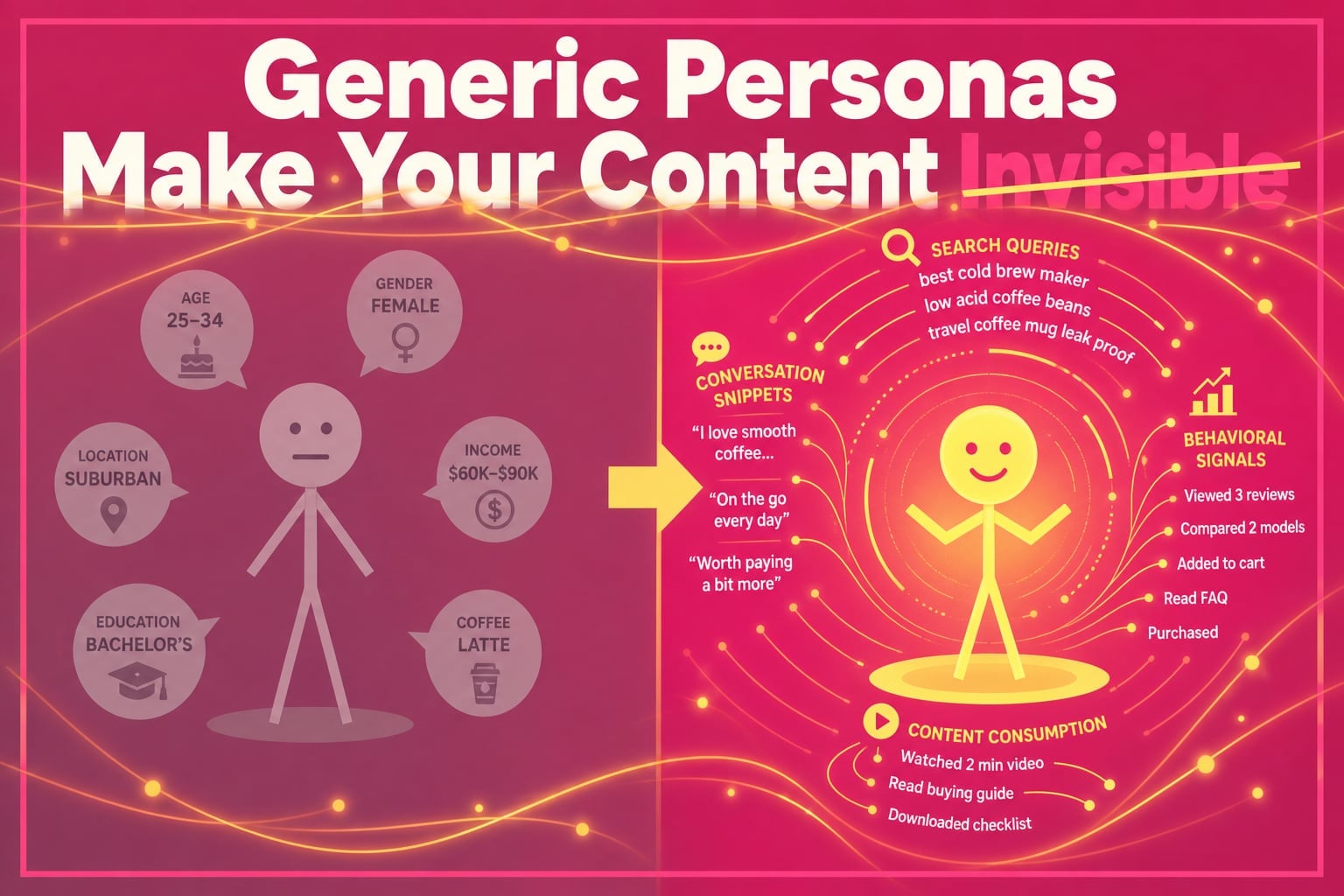
Why Generic Audience Personas Make Your Content Invisible and How AI Can Fix It
Quick Answer: How Do Generic Audience Personas Hurt Your Content?
Generic audience personas are shallow, assumption-based profiles that describe imaginary customers using broad demographics like age, job title, and location, without capturing real motivations or behaviors.
Here is the uncomfortable truth: most personas are fiction dressed up as strategy. You built "Marketing Manager Mike, 34, loves coffee" and called it research. Mike is not a person. Mike is a guess. And content built on guesses gets ignored.
According to ClearVoice, 89 percent of marketers using personalized campaigns see a positive ROI. The gap between those marketers and everyone else? Their personas are built on real behavioral data, not boardroom assumptions.
What Are Generic Audience Personas and Why Do Marketers Still Use Them?
A generic audience persona is a static, demographic-first profile built from internal assumptions rather than observed customer behavior, search patterns, or real conversation data.
Marketers keep using them because they are fast and feel productive. A two-hour workshop produces a laminated poster. The poster goes on the wall. Everyone feels aligned. Nothing changes.
The problem is structural. Product Marketing Alliance notes that personas only work when they reflect the real decisions, barriers, and daily friction your buyers actually experience. A job title tells you nothing about why someone clicks or why they bounce.
When personas stay theoretical, teams default to generic messaging. When personas are grounded in behavior, the content gets sharp. That is the whole game.
How Does AI Audience Research Actually Work?
AI audience research is the process of using machine learning and natural language tools to analyze real behavioral signals, including search queries, social conversations, and purchase patterns, and turn them into specific, actionable audience profiles.
You are probably still running surveys and calling it audience research. Here is what that costs you: static data that is outdated before the ink dries.
AI tools like SparkToro and GWI pull from live behavioral signals across 50-plus markets, showing you what your audience actually reads, watches, and searches. That is a different category of insight than a focus group from last spring.
The results are not marginal. M1-Project research shows companies using AI in market research see a 33 percent average boost in conversion and a 28 percent reduction in customer acquisition cost. AI-augmented research also shortens time-to-insight by over 60 percent.
Coolest.Agency's approach takes this further by learning your brand voice continuously, so the personas it builds stay aligned to how your brand actually sounds, not just who your audience is.
Case Study: From Invisible to Irresistible, A Brand's AI Persona Glow-Up
Automate your entire content operation
Generate, publish, and track a month of posts on autopilot.
Start Free →
A synthetic focus group is an AI-moderated research method where simulated personas, built from real customer data, debate messaging and surface objections before a single dollar is spent on distribution.
The Times (UK) ran exactly this experiment. Working with Electric Twin in 2025, they built a synthetic audience panel modeled on real reader data to pressure-test editorial and commercial content. The result: faster feedback loops and messaging validated against actual reader psychology, not editorial instinct.
This is the model worth copying. Build the persona from behavioral data. Run it through a synthetic focus group. Stress-test your content before it goes live. Harvard Business Review calls this shift in gen AI market research one of the most significant changes to strategic marketing in a generation.
Generative AI is rapidly reshaping market research by enabling the creation of synthetic personas and digital twins, AI-generated proxies that can simulate how real customers think and respond.
Jeremy Korst, Founder, Mindspan Labs and Partner, GBK Collective, writing in Harvard Business Review, November 2025
How to Start Using AI for Generic Audience Personas Without Losing Your Mind
AI-driven persona building is a step-by-step process of feeding real behavioral inputs into research tools and iterating on the output until the profile reflects actual customer psychology, not demographic averages.
Start here. Do not boil the ocean.
- Step 1: Pull your top 3 performing content pieces. Ask an AI tool what behavioral traits the audience shares, not who they are, but what they do and why.
- Step 2: Use social listening tools to find the exact language your audience uses when they describe their problems. That language goes directly into your content.
- Step 3: Run a synthetic focus group on your next campaign before publishing. Tools like Symar.ai let you simulate audience reactions in minutes.
- Step 4: Update your personas every quarter. Behavioral data shifts. Your personas should too.
Coolest.Agency automates the social publishing side of this workflow, so once your AI-built personas inform your content plan, you can set your social strategy over a cup of coffee and let it run.
Key Takeaways: Making Your Content Unskippable Without Generic Audience Personas
Unskippable content is content built on specific behavioral truth: what your audience fears, wants, and searches for right now, not six months ago.
Netflix increased retention by 75 percent by applying machine learning to deliver personalized content at scale, per M1-Project. They did not guess. They measured.
Your next step is concrete: take one existing persona, run it against a real behavioral data source this week, and identify one assumption that does not hold up. Fix that assumption. Rebuild from there.
Generic personas make you invisible. Behavioral ones make you impossible to ignore.