← Back to blog

The Myth of Prompt Engineering: Why It’s the New Busywork Is Holding You Back

E

· 13 May 2026 · 5 min read

The Myth of Prompt Engineering: Why It’s the New Busywork Is Holding You Back

The Prompt Engineering Myth: Why Busywork Is Holding Your AI Strategy Back

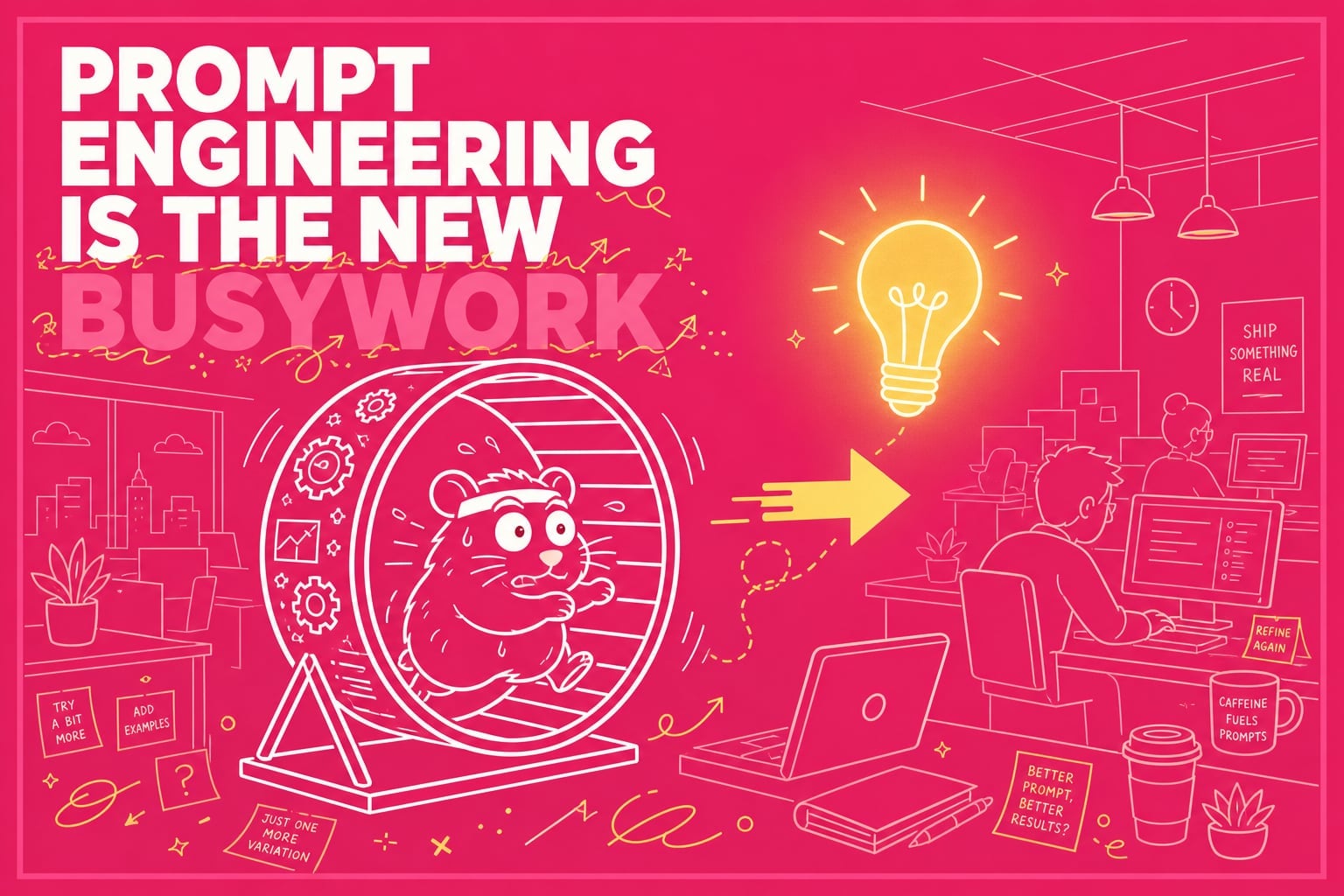
You have rewritten the same prompt 37 times this week. You swapped "act as" for "you are," added three more context sentences, and watched the output change by almost nothing. That is not mastery. That is a hamster wheel. The prompt engineering myth says better prompts equal better results. The truth is messier, and fixing it is faster than you think.

Key Takeaways: What Is the Prompt Engineering Myth?

The prompt engineering myth is the widespread belief that obsessive prompt refinement is the primary driver of elite AI output, when the real lever is how you structure human expertise alongside AI systems.

Most articles on this topic will tell you to write longer prompts, add more examples, and chain your reasoning. Here is the part they skip: research across 1,500 academic papers found that structured short prompts reduced API costs by 76% while maintaining the same output quality. Longer is not smarter. Structured is smarter.

The gap nobody talks about: prompt tweaking is a symptom of a missing workflow, not a skill gap.

Why the Prompt Engineering Myth Became the New Busywork in AI Content Creation

Prompt engineering busywork is the cycle of endlessly adjusting AI inputs for marginal gains while ignoring the upstream decisions that actually shape output quality: brand voice, strategic intent, and workflow architecture.

It happened because the earliest AI wins came from clever prompts. That made prompting feel like the whole game. But models have improved dramatically. The ceiling on prompt cleverness is lower than it used to be, and the floor on strategic context is higher.

When someone can't write clear instructions for a human colleague, they won't suddenly write better instructions for a machine. The issue isn't the secret prompt formula. It's that they never developed the underlying cognitive and linguistic competencies that make any form of clear instruction possible.

Carmel Wenga, Content Strategist and Linguistics Researcher, The Strategic Linguist (Substack, 2025)

Translation: prompt problems are usually thinking problems. No template fixes that.

What Actually Delivers Better AI Output (Hint: It Is Not Prompt Hacking)

Better AI output comes from giving the model persistent context about your brand, audience, and goals, not from one-off prompt tricks applied at the last second.

Think of it this way. You would not hire a brilliant copywriter and then re-brief them from scratch every single day. You would give them a brand guide, a tone of voice document, and a content strategy. AI works the same way.

Systematic improvement processes compound to a 156% performance improvement over 12 months compared to static prompts. That is not a prompt hack. That is a workflow.

Automate your entire content operation

Generate, publish, and track a month of posts on autopilot.

Start Free

Coolest.Agency's approach addresses exactly this: instead of prompting from scratch each time, the system learns your brand voice and stays aligned to it across every piece of content, so your team sets the plan once and the output stays consistent.

How Top Teams Combine Human Expertise with AI for Elite Results

Human-AI collaboration in content creation means humans own the strategic and creative direction while AI handles speed, scale, and pattern execution, with structured handoffs between the two.

Jared Sanborn's team at PureBrain.ai completed over 1,000 human hours of work in under 60 hours of AI-assisted review time in February 2026. His conclusion was direct: the difference was not prompts. It was giving AI a defined job, a name, and a clear set of rules, like a real hire.

That is the centaur model in practice. Humans bring intuition, brand judgment, and ethical guardrails. AI brings throughput. Neither replaces the other. You are probably skipping the brief and going straight to the prompt. That is where the hours disappear.

How to Future-Proof Your AI Content Strategy Beyond the Prompt Engineering Myth

A future-proof AI content strategy is one built on reusable context, structured workflows, and human creative direction rather than one-off prompt experiments that reset with every session.

Here is a practical framework to shift out of busywork mode:

  • Build a brand context document. Tone, audience, style, and off-limits topics. Load it every session or bake it into your system.
  • Segment by task, not by prompt length. Chain-of-thought prompting adds latency and cost when the task is simple classification or summarization. Match technique to task.
  • Measure output, not effort. If you cannot track whether a prompt change improved results, you are iterating blind.
  • Automate the repeatable parts. Social planning, content calendars, and recurring formats should not require a fresh prompt every time.

Coolest.Agency provides exactly this kind of structured workflow: you set your social marketing plan over a cup of coffee, the system publishes it, and your brand voice stays consistent without daily re-prompting.

Context engineering, not prompt engineering, is what reduces back-and-forth and increases consistency in AI workflows built for scale.

Your next step: Write a one-page brand context document this week. Name your audience, your tone, your three content goals, and two things your brand never says. Load it into every AI session. That single document will do more for your output quality than 37 prompt rewrites ever will.

Ready to put your marketing on autopilot?

Join teams that ship more content in a week than most do in a month.

Get Started Free

Automate your content

Start Free