← Back to blog

The Fact-Checking Playbook That Keeps AI Hallucinations Out of Your Published Content

E

· 9 June 2026 · 5 min read

The Fact-Checking Playbook That Keeps AI Hallucinations Out of Your Published Content

The Fact-Checking Playbook That Keeps AI Hallucinations Out of Your Published Content

Fact checking AI content is the single workflow your publishing process cannot afford to skip. Research published in 2025 puts hallucination rates between 20% and 60% depending on the knowledge domain. That is not an edge case. That is a structural publishing risk sitting inside every AI draft you send live.

Key Takeaways
  • 60% hallucination risk in some domains means every AI draft needs a structured review, not a quick skim.
  • Isolate claims first. Verify each one against a primary source before anything else moves.
  • A Human-in-the-Loop layer only works when reviewers have clear context and real override authority.
  • Automation complacency is the silent killer: fatigued reviewers approve errors that a fresh eye would catch.
  • A feedback loop that logs errors improves your AI outputs over time and shrinks your review burden.

Why AI Hallucination Rates Should Change How You Publish

AI hallucinations are confident, fluent, completely fabricated outputs that language models generate when pattern-matching outpaces factual grounding. Hallucination rates range from 20% to 60% depending on the knowledge domain, per Lee et al., 2025. That number should rewire how you think about every piece of AI-assisted content you publish.

The risk is not hypothetical. In 2024, Air Canada was ordered by a tribunal to honor a bereavement fare policy that its support chatbot had entirely invented. The tribunal rejected Air Canada's defense that the chatbot was a "separate legal entity." The brand owned the error, per documented hallucination cases on Wikipedia.

Hallucination Rate Spectrum
General knowledge domains: ~20% hallucination rate
Specialized/technical domains: up to 60% hallucination rate
Source: Lee et al., 2025, ScienceDirect

Publishing without a verification layer is not a time-saver. It is a trust debt you pay later, in corrections, retractions, or worse. The next section hands you the exact system that stops bad outputs before they leave your desk.

A Step-by-Step System for Fact-Checking AI-Generated Content

Every AI-generated stat, name, date, and claim needs a primary-source check before publishing. Treating AI output as a first draft, not a finished product, is the single biggest shift that prevents misinformation from reaching your audience.

Picture this: your writer pastes an AI draft into the CMS, scans it visually, and hits publish. Three days later, a reader flags a fabricated citation. Sound familiar? Here is the four-stage workflow that catches it first.

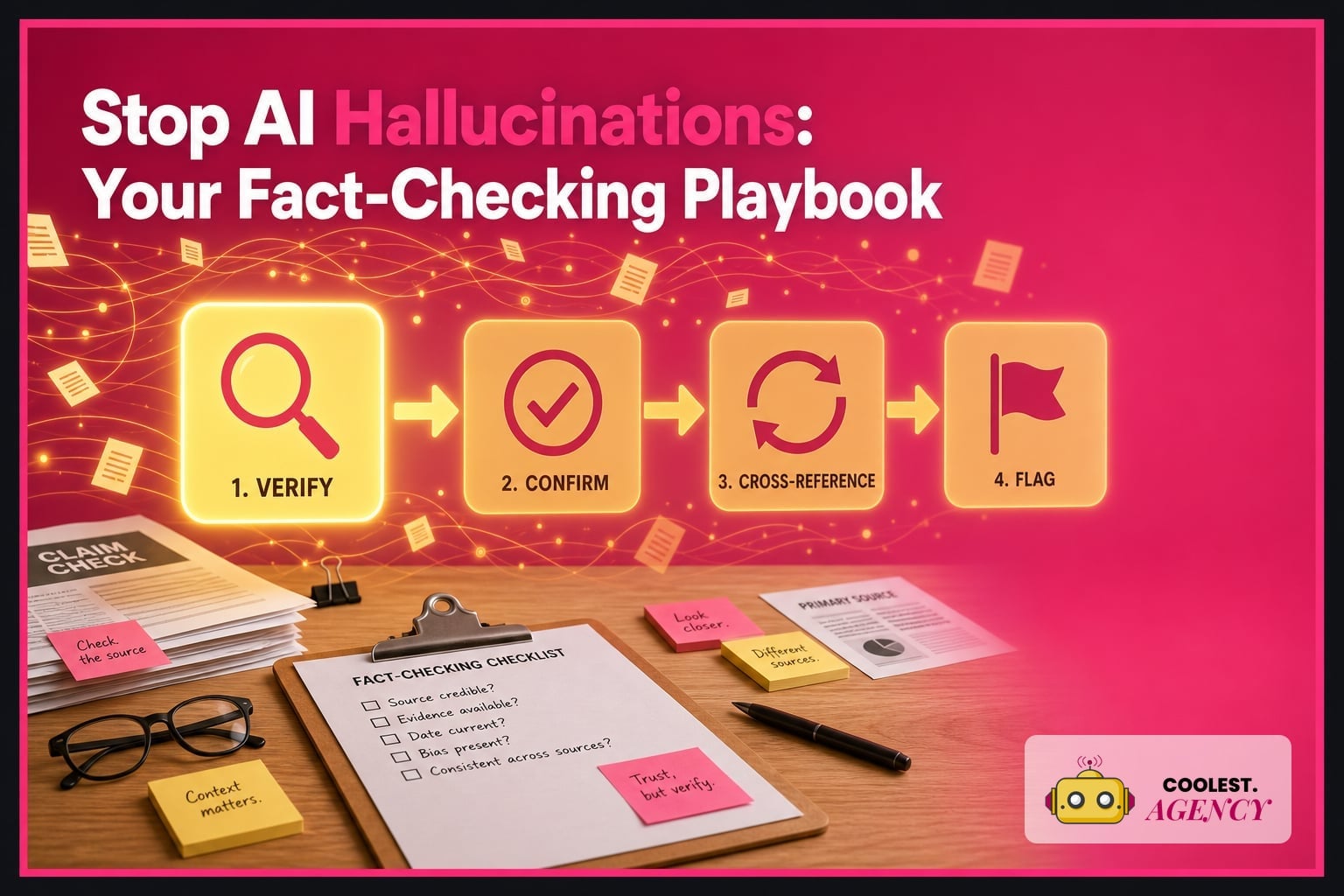
4-Stage Fact-Checking Workflow
  1. Isolate Claims: Highlight every stat, name, date, and causal assertion as a discrete item. Do not read for flow; read for checkable facts.
  2. Verify Sources: Trace each claim to a primary source. If the AI cited a URL, open it. If the page does not exist or does not contain the claim, flag it immediately, per IBM's hallucination guidance.
  3. Cross-Reference: Check key stats against a second independent source. One confirmation is not enough for high-stakes claims.
  4. Flag or Approve: Use a simple status tag: Verified, Needs Revision, or Remove. Nothing moves to publish without a status.

Automate your entire content operation

Generate, publish, and track a month of posts on autopilot.

Start Free

One prompt-engineering technique that cuts false statistics by 67%: ask the AI to flag uncertain claims itself before you review, per tested techniques shared on r/PromptEngineering. That one step alone surfaces the riskiest sentences before your reviewer even opens the doc.

Coolest.Agency's approach to content workflows builds this four-stage check directly into the drafting process, so the AI generates smaller, verifiable chunks rather than one long draft that buries errors in plain sight.

The Human-in-the-Loop Layer That Keeps Your Team From Going on Autopilot

A Human-in-the-Loop (HITL) review layer is a structured process where a human reviewer holds explicit authority to override, revise, or reject AI outputs at defined checkpoints before content is published.

Here is the rebuttal you need to hear: most teams think they already have a human review step. They do not. They have a human rubber-stamp step. Fatigued reviewers who face a wall of AI text with no highlighted claims and no clear decision criteria will approve errors. Every time.

When humans review AI content, their cognitive load must be managed. Present reviewers with clear context, highlighted data, and simple approval options to prevent automation complacency, where tired humans blindly approve AI mistakes.

Irina Georgieva, AI Content Strategist, Coolest.Agency, via internal content workflow guidelines
Automation Complacency Warning
When reviewers see dozens of AI drafts daily, approval becomes habitual. Structure breaks the habit. Highlighted claims, a defined checklist, and a logged decision trail are not bureaucracy; they are the difference between a review and a formality.

Build a feedback log. Every flagged hallucination gets recorded with the prompt that produced it. Over time, you train both your team and your AI prompts to produce fewer errors. That loop is what separates a one-time fix from a durable system.

Coolest.Agency provides tools that learn your brand voice and stay aligned to it across every publish cycle, so the content that reaches your reviewer is already calibrated, not raw output from a generic model.

Your Next Move

You now have the full system: a four-stage claim verification workflow, a HITL structure that prevents rubber-stamping, and a feedback loop that compounds over time. The gap between brands that build trust and brands that quietly erode it is exactly this process.

See how a reasoning-first content workflow catches what a solo fact-check misses: explore the full Human-in-the-Loop content framework at Coolest.Agency and wire it into your publishing process today.

Ready to put your marketing on autopilot?

Join teams that ship more content in a week than most do in a month.

Get Started Free

Automate your content

Start Free

We use essential cookies to run Coolest.Agency and, with your permission, analytics and advertising cookies to improve it and measure our campaigns. Learn more.