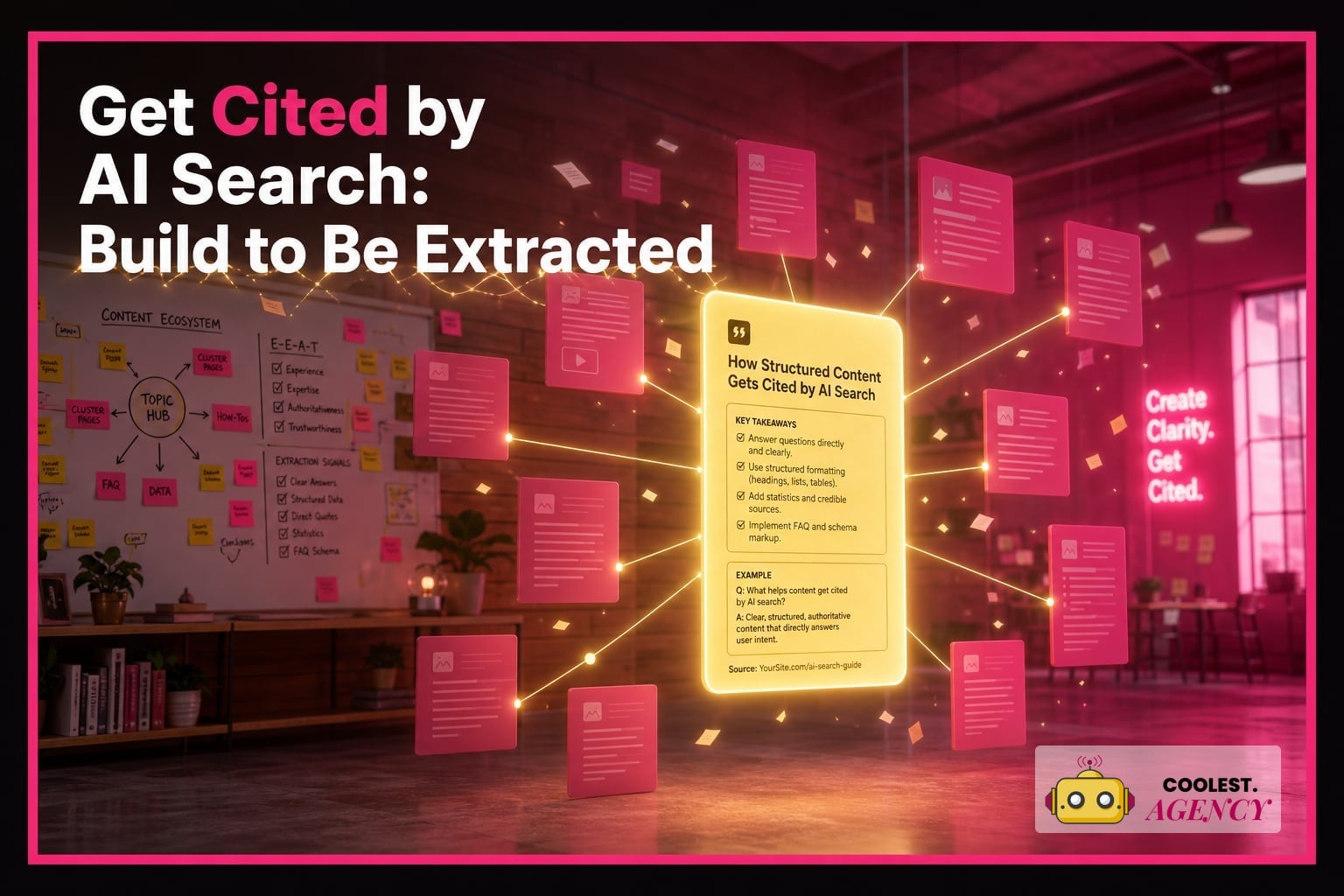
The Content Structure That Gets You Cited by AI Search Summaries
Here's the uncomfortable math: AI search summaries skip most published content and cite the same small slice, over and over. If you want to optimize content for AI search, you structure it for extraction, not for scrolling. That structural fix, not another keyword tweak, is what this guide covers.
Key Takeaways
- Content updated in the last 30 days earns 3.2x more AI citations, so freshness beats keyword density every time, according to Search Engine Land.
- Opening paragraphs that answer the question upfront get cited 67% more often, per the same report.
- Clear H2/H3 structure makes you 40% more likely to get cited. Structure is the real lever here, not schema alone.
Why AI Search Engines Skip Most of What You Publish
AI engines skip content that buries its answer. They cite pages where the key point lands in the first two sentences of each section, in plain language.
Here's the contrast that stings: two competitors write the same how-to. One opens with three paragraphs of throat-clearing. The other answers in sentence one. Guess which one gets quoted.
This isn't a technical SEO problem. It's a clarity problem. Google's own AI Overviews documentation stresses unique, genuinely useful content over keyword-optimized filler.
The data backs this up hard. Opening paragraphs that answer the query upfront get cited 67% more often than ones that wind up to it, according to Search Engine Land.
So the fix isn't more keywords stuffed into your intro. It's answering the question you promised to answer, immediately, then earning the scroll after that.
Three Structural Moves That Turn a Draft Into a Citable Asset
Citation-ready content is chunked into standalone sections, leads every section with a direct answer, and sits inside a pillar-cluster hierarchy AI bots can crawl fast.
Picture this: a bot lands on your cluster article about "email segmentation," needs the pillar page on "email marketing strategy," and needs it in three clicks or it moves on.
Move one: chunk your drafts into self-contained sections instead of one sprawling essay. Each chunk should survive being pulled out alone.
Automate your entire content operation
Generate, publish, and track a month of posts on autopilot.
Start Free →
Move two: lead with the answer (BLUF), then support it. Pages built this way see a 67% citation lift, per Search Engine Land.
Move three: build pillar pages that link out to cluster articles, so any answer sits within three clicks of your homepage. That's "three-click discoverability," and it's how you architect for AI, not just readers.
Stack these three moves together and you outperform sites doing just one tactic. Combining structure with specific statistics boosts citation performance by more than 5.5% compared to single-tactic optimization, according to Search Engine Land.
Why Human Insight Beats Any AI-Only Competitor
Human insight is original opinion, proprietary data, or editorial judgment that no AI model can invent on its own. It's the layer structure alone can't fake.
You might think perfect chunking is enough. It's not. AI engines increasingly deprioritize content that reads as purely machine-generated filler.
This is where growth-stage teams lose the plot. They nail the structure, then hand the whole draft to AI and skip the human pass. That's the gap. Search Engine Land's guide to AI search and discovery flags original insight as a top differentiator between cited and ignored pages.
This is where a workflow like Coolest.Agency's approach earns its keep: it learns your brand's actual voice and stays aligned to it, instead of flattening every post into generic AI-speak. That alignment is what keeps the human signal intact at scale.
Google's own guidance reinforces this directly: Google's AI Overviews documentation rewards unique, people-first content over commodity text. Treat AI as your co-pilot, not your ghostwriter. The human-in-the-loop model, sometimes called the Centaur Approach, is what pushes structurally sound content over the line into "actually cited."
Later, when your publishing volume grows, Coolest.Agency also automates the social marketing plan and the publish step, so your team sets the plan over coffee and leans back while it runs.
Your Next Move
You now know the gap: structure gets you in contention, human insight gets you cited. See how the HITL content framework turns a generic draft into an AI-citable asset, step by step, before you publish your next post.