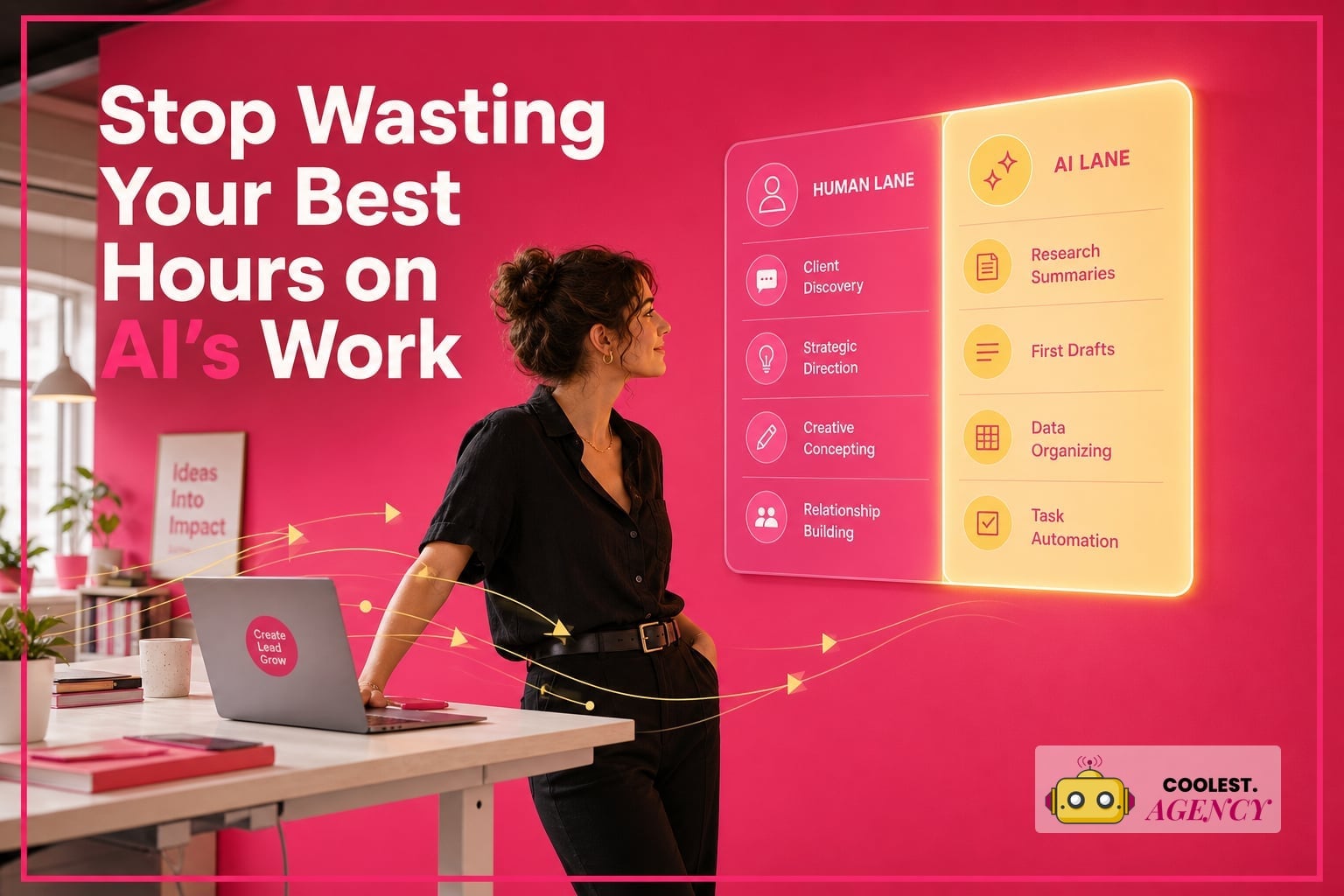
The Tasks You Should Hand to AI So Your Agency Team Gets Its Best Hours Back
Here is the uncomfortable math nobody puts in a pitch deck: most of what fills your team's calendar is not the work clients are paying for. AI in agency work is best used to swallow the repetitive stuff so your strategists get their time back, and Microsoft's own usage data backs this up. Only 17% of AI conversations inside Microsoft 365 Copilot involve actually producing work, with the rest split between analysis, finding information, and collaborating with people Microsoft's 2026 Work Trend Index. That gap between what AI could take and what it actually takes is where your margin is hiding.
Key Takeaways
- 49% of workplace AI use already supports thinking, not typing, so the tools are ready for judgment-adjacent work, per Microsoft's 2026 Work Trend Index.
- Automating reporting and lead scoring cuts manual labor by up to 40%, according to Vendasta, hours that belong back in strategy sessions.
- 88% of organizations already use AI somewhere, yet most see nothing on the bottom line, per Saner.AI's 2026 report, because nobody drew a line for who owns what.
- 87% of agencies employ under 50 people, per Promethean Research, which means every reclaimed hour hits your margin directly.
The Tasks Quietly Eating Your Best People's Time
Content drafting, data formatting, client reporting, and social scheduling consume the majority of an agency's working hours, and none of them require a creative brief to execute well. That is the part that should sting: your strategist's afternoon is going to a pivot table, not a pitch.
I have watched senior account managers spend two hours assembling a monthly report a spreadsheet could generate in ten minutes. Multiply that across a twelve-person team and you are burning a full workweek every month on formatting alone.
The numbers confirm the scale of the leak. Automating workflows like lead scoring and reporting reduces manual labor by up to 40%, per Vendasta's agency automation research. One agency owner who ran a twelve-person shop for six years automated 80% of repetitive work by year six, cut his hours to 35, and grew revenue 40% in the process AutomateKit's agency automation guide.
That is not a productivity tip. That is a 40% revenue lift and a 35-hour week architected inside a to-do list. If your retainer is worth $5,000 a month, reclaiming 40% of your team's hours is the most valuable line item you never invoiced.
Where to Draw the Line Between What AI Owns and What You Own
AI owns speed and volume. Humans own judgment, taste, and stakes. The handoff point sits wherever a wrong call would cost you a client, a campaign, or your credibility in the room.
Automate your entire content operation
Generate, publish, and track a month of posts on autopilot.
Start Free →
That is the whole framework. One question, no flowchart required: if this goes wrong, who takes the blame?
If the answer is nobody notices, hand it to AI. If the answer is the client fires you, keep it human. A first draft of a report is AI's lane. Deciding what that report means for the client's Q3 budget is yours.
Think of it like a Grandmaster Chess player: the engine calculates every move at blinding speed, but the Grandmaster decides which game is worth playing. A generic social caption generated in bulk is the engine's move. A repositioning strategy for a client losing market share is the Grandmaster's.
The tension is real. BCG consultants using AI inside their skill zone completed 12.2% more tasks, 25.1% faster, at 40% higher quality, but were 19 percentage points more likely to be wrong the moment they stepped outside it Saner.AI's 2026 report. Speed inside the lane. Danger outside it.
Microsoft's data shows the appetite is already there: 49% of AI conversations at work now support cognitive tasks like analysis, not just production Microsoft's 2026 Work Trend Index. The tools are ready to sit closer to judgment than most teams let them. Just not past the line.
What to Do With the Hours AI Gives Back to Your Team
Reclaimed hours default straight back into more production unless you actively redirect them, and most teams never make that redirect. Picture the trap: your account manager gets three hours back from automated reporting, and by Thursday she has filled them with three more decks nobody asked for.
That is the quiet failure mode of agency automation. You buy the tool, the hours appear, and then production expands to fill the space, like a gas leak with no shape until it fills the room.
Specialist roles at well-run agencies bill 75 to 85% of their time, per Sakas & Company's agency roles research. Strategists should not be bleeding into that specialist band, doing formatting work a specialist or a tool could own instead.
The fix is deliberate reassignment, not hope. Block the recovered hours on the calendar before the AI tool ships. Name them: client strategy sessions, positioning work, the pitch you keep postponing.
Here is what that looks like in practice: AI drafts the report, a human strategist reviews it for what the client actually needs to hear, then it goes out with a point of view attached, not just numbers. That middle layer, the judgment layer, is the only part of the workflow that still justifies your retainer.
In my own work across agency teams, the shops that protect that middle layer are the ones whose retainers grow. The ones that don't just get faster at producing the same commodity work, for the same fee, until someone undercuts them on price.
Everyone has the same AI tools now. The unfair advantage belongs to the operators who leverage those tools to architect something nobody can reverse-engineer: a team that spends its best hours on the work that actually disrupts what clients expect from an agency.
This framework disrupted how I run every engagement I take on. The line I drew added margin I stopped apologizing for. Where you draw yours is the most consequential decision your agency makes this year. Drop it in the comments.