← Back to blog
OODA Loop marketing strategymarketing adaptability modelfreelance content strategyOODA Loop stepsmarketing decision-making model

The Military Decision Model That Gives Freelance Marketers an Unfair Advantage Over Platform Shifts

E

· 30 September 2026 · 4 min read

The Military Decision Model That Gives Freelance Marketers an Unfair Advantage Over Platform Shifts

The Military Decision Model That Gives Freelance Marketers an Unfair Advantage Over Platform Shifts

Algorithm changes don't kill freelance content managers. Slow decisions do. OODA Loop marketing is the fix: a four-stage decision cycle built by a fighter pilot to move faster than the threat, and it works just as well against a Meta algorithm update as it does against an enemy jet. Run it right and platform chaos stops being your problem. It becomes your opening.

Key Takeaways

  • A solo operator running tight decision cycles can beat a 10-person in-house team to a trend, because speed of decision beats headcount every time.
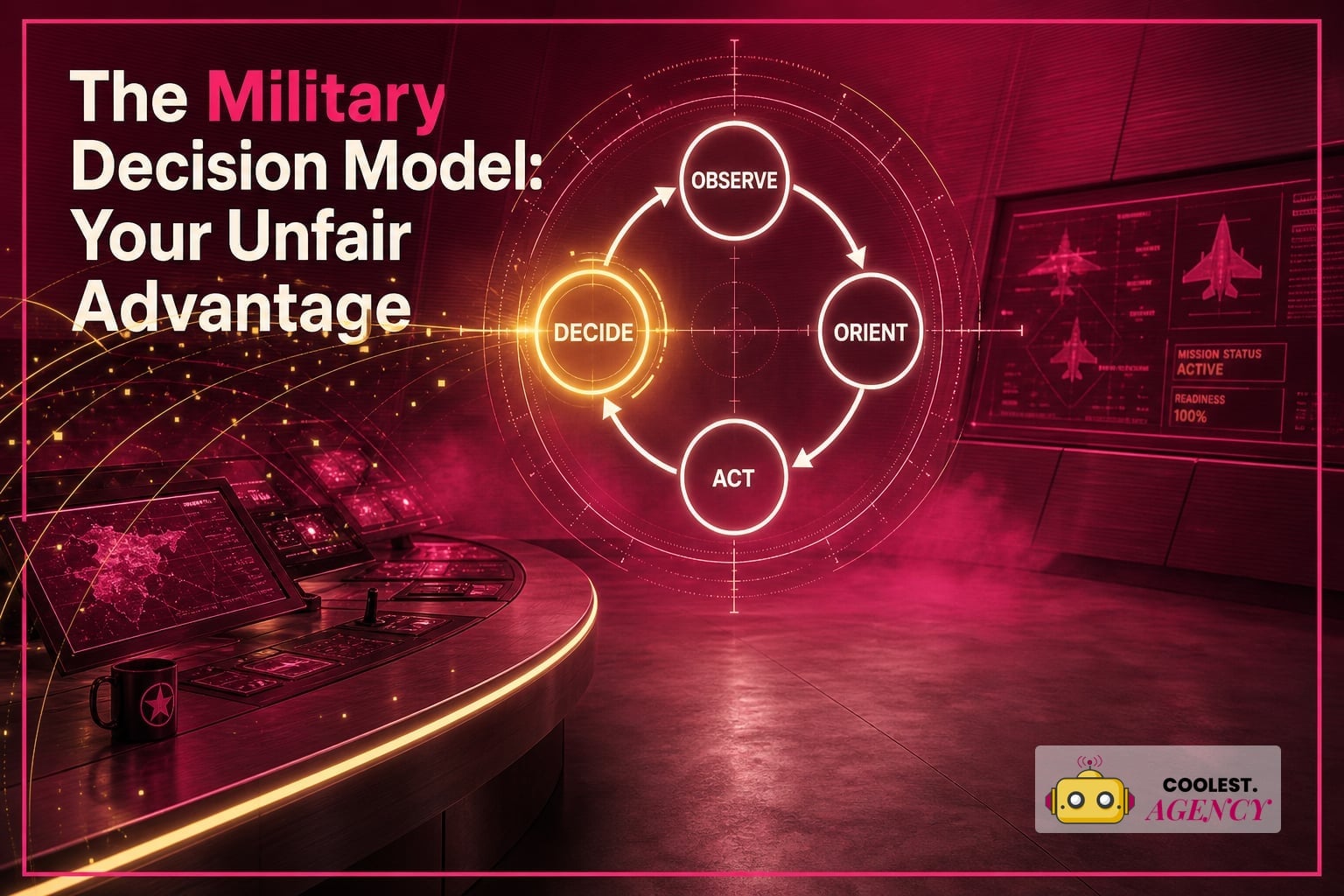
  • The OODA Loop, built by Colonel John Boyd, has four stages: Observe, Orient, Decide, Act, and each one maps directly to a freelance workflow.
  • 47% of marketers say automation is a top trend they are exploring right now, per HubSpot's 2026 State of Marketing report, which means the freelancers who compress their cycle first will own the window.
  • Real-time budget rebalancing lifts ROI by 15%, per M1-Project, proof that fast redeploys beat static plans.

What the OODA Loop Actually Does for Marketing Decisions

The OODA Loop, Observe, Orient, Decide, Act, is a decision-speed framework built by U.S. Air Force Colonel John Boyd that lets you cycle through market signals faster than the account managers watching the same platform. Boyd built it to win dogfights, not client retainers, but the logic transfers cleanly: whoever completes the loop first controls the engagement, according to Farnam Street.

Here's the contrast that matters. A reactive marketer waits for a platform change to fully unfold, reads five newsletters about it, then acts once it's already old news. An OODA-driven operator treats the same change as raw signal, orients it against each client's context, and acts inside a single cycle, per The Decision Lab.

You are not managing content anymore. You are running reconnaissance. That distinction is the entire unfair advantage.

How to Run Each OODA Stage as a Freelance Content Manager

Each OODA stage maps to one concrete move: Observe (track signal sources daily), Orient (filter the signal through each client's brand and audience), Decide (commit to one content bet, not five), Act (publish, then log what happened). A full cycle should close in days, never quarters.

Picture this: Instagram quietly throttles carousel reach on a Tuesday. Observe means you catch the dip in your own analytics dashboard before a client emails you panicking. Orient means you ask what that means for a logistics client versus a wellness client, per Umbrex. Decide means you pick one format shift, maybe short-form video, and commit. Act means it's live by Thursday, with results logged for the next loop.

Automate your entire content operation

Generate, publish, and track a month of posts on autopilot.

Start Free →

Freelancers already juggling 3 to 5 clients tend to skip the log step, the one that turns a single scramble into a repeatable system, per MBA Knowledge Base. That habit is exactly what separates how small marketing teams are architecting smarter content workflows from operators still fighting fires client by client.

This is also where the case for a Strategic Partner gets concrete. Coolest.Agency's Influencer Tier publishes 30 social posts a month directly to Facebook, LinkedIn, Instagram, or X, which shortens the Act stage from a scramble into a standing pipeline you set once and monitor.

The Unfair Advantage: Why Faster OODA Cycles Beat Bigger Teams

A solo freelancer running tight OODA cycles can out-maneuver a 10-person in-house team, because decision speed, not headcount, decides who captures a trend first. Big teams lose time to approval chains. You don't have one to lose.

Skeptical that lean beats big? Harvard Business Review has documented how disciplined, fast decision cycles consistently outperform scale in volatile conditions, whether the arena is M&A or a client's content calendar. Tight loops compound. Committees don't.

Umbrex frames a clarified metric and a fast cycle as the core mechanism of measurable gains, the same logic that lets one operator run circles around a slower org chart, per Umbrex.

This is the moment to stop apologizing for being a one-person shop and start treating it as the format built for speed. Coolest.Agency's Content Strategist offers a human strategist who builds and runs that strategy alongside you, which is one path to agency-scale output as a solo operator without hiring a single junior. You just keep the wheel.

If running tighter OODA cycles is the strategy, the next question is execution speed. See how a Content Strategist can take the Observe-to-Act cycle off your plate, while you stay in control of keeping creative control inside a fast decision cycle.

Ready to put your marketing on autopilot?

Join teams that ship more content in a week than most do in a month.

Get Started Free →

Automate your content

Start Free →

We use essential cookies to run Coolest.Agency and, with your permission, analytics and advertising cookies to improve it and measure our campaigns. Learn more.