AI Marketing Content: A Human-in-the-Loop Approach That Actually Works
AI marketing content is everywhere. Nearly 90% of marketers now integrate AI into their processes in some form, per Loopex Digital's 2026 AI Marketing Report. But speed without judgment is just noise at scale. The brands winning right now are not the ones using AI the most. They are the ones using it the most carefully.
Quick Answer: What Is Human-in-the-Loop AI Marketing Content?
Human-in-the-loop (HITL) AI marketing content is a workflow where humans actively review, correct, and guide AI output at every stage, rather than publishing raw AI drafts. Google Cloud defines HITL as a design approach where humans stay inside the feedback loop between AI systems and real-world outcomes.
Here is the part most articles skip: HITL is not a safety net for bad AI. It is a productivity multiplier for good marketers. The AI handles volume. You handle judgment. Together, you produce something neither could alone.
Why AI Alone Is Not Enough for Effective AI Marketing Content
AI-only content is content that sounds confident but can be quietly wrong. Generative AI produces plausible-sounding text that can contain fabricated statistics, invented quotes, and outdated claims presented as fact.
You are probably skimming AI drafts and approving them fast. Here is why that costs you. Adobe's 2026 AI marketing research found that 53% of senior executives using generative AI report significant efficiency gains, but efficiency and accuracy are not the same thing. One wrong stat in a published piece can undo months of trust-building.
The fix is not less AI. It is smarter human checkpoints built into the process before content goes live.
How to Build a Human-in-the-Loop Workflow for AI Marketing Content
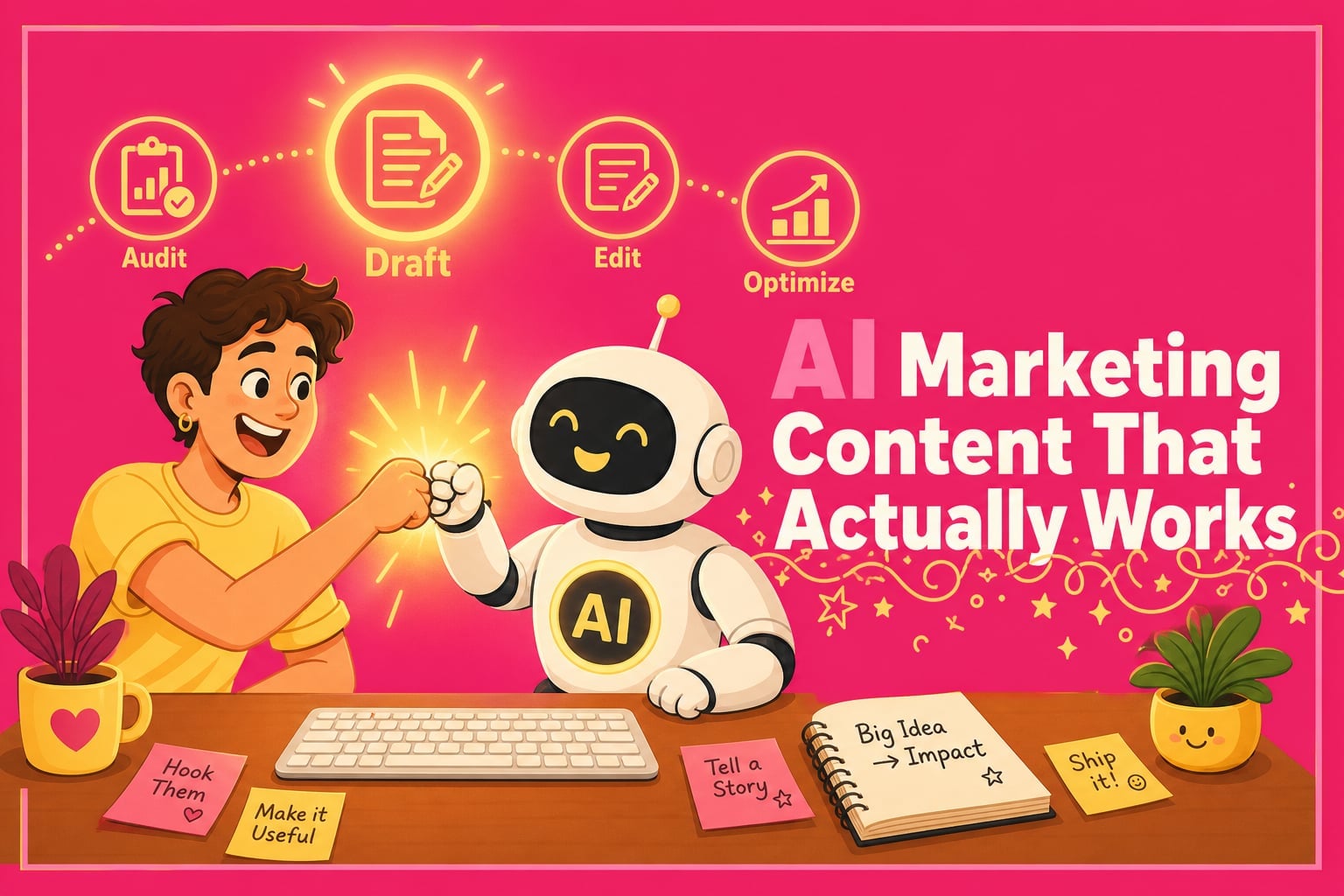
A HITL workflow for AI marketing content is a repeatable four-stage cycle: audit intent, generate a draft, edit for truth and voice, then optimize for performance before publishing.
Here is the framework, stage by stage:
- Stage 1: Audit intent. A human defines the goal, audience, and off-limits topics before the AI writes a single word. This is your brand guardrail, not an afterthought.
- Stage 2: Generate in sections. Prompt AI to write one section at a time, not a full article. Smaller outputs mean fewer errors and easier human review.
- Stage 3: Edit for truth and voice. A human checks every statistic, injects proprietary insight, and rewrites anything that sounds robotic or generic.
- Stage 4: Optimize and publish. A final human pass confirms tone, compliance, and brand alignment before anything goes live.
Marketing teams running this cycle report 44% higher productivity and save an average of 11 hours per week, according to Loopex Digital. That is time you reinvest in strategy, not proofreading.
Automate your entire content operation
Generate, publish, and track a month of posts on autopilot.
Start Free →
Coolest.Agency's approach takes this further by automating the social publishing layer of the workflow. It learns your brand voice over time and keeps every post aligned to it, so your team focuses on strategy while the scheduling runs itself.
Injecting Brand Voice and Ethics: The Playbook for Ethical AI Content Writing
Ethical AI content writing means producing content that is accurate, transparent about AI's role, and consistent with your brand's values, without outsourcing creative judgment to a machine.
Brand voice is the first casualty of lazy AI use. Generic prompts produce generic output. The fix is a "personality architecture": a documented set of your brand's tone rules, forbidden phrases, and emotional thresholds that you feed into every prompt before generation begins.
On the ethics side, only 26% of consumers trust brands to use AI responsibly, per Statista. That gap is your opportunity. Brands that disclose AI use and maintain human editorial oversight build trust faster than those that do not.
Ethical AI involves using tools to assist in creating high-quality, audience-focused content while maintaining human oversight and transparency. Google doesn't penalize AI content outright but deprioritizes material that fails to meet its quality standards.
Neil Patel, Co-founder, NP Digital, via NP Digital Blog, 2025
Case Study: Fixing AI-Generated Content with Human Oversight
NP Digital ran a real test of what happens when human oversight is removed from the content process. The result was not what most people expect.
One piece written entirely by humans was flagged as AI-generated by a syndication partner's detector. Meanwhile, AI-assisted content with strong human editing passed review and outperformed. The team applied a structured HITL editing process across their content pipeline. Monthly organic impressions increased 32% and organic clicks grew 28%.
The lesson is not that AI detectors are broken (though they often are). The lesson is that human editing is what makes AI content perform. The detector story is a footnote. The 32% traffic lift is the point.
Key Takeaways: Your Next Steps for Smarter AI Marketing Content Creation
Smarter AI marketing content creation means combining AI's speed with human judgment at every stage, not choosing one over the other.
CoSchedule's 2025 State of AI in Marketing report found that AI users are 25% more likely to report marketing success than those who do not use AI. But the gap closes fast if your AI content is inaccurate or off-brand.
Here is what to do this week. Build your four-stage HITL cycle. Document your brand voice rules. Assign a human fact-checker to every AI draft before it publishes. Tools like Coolest.Agency can automate your social publishing plan so you set it up once and the content goes out consistently, without your team babysitting a scheduler.
The marketers who win with AI are not the fastest publishers. They are the most deliberate editors. Start there.