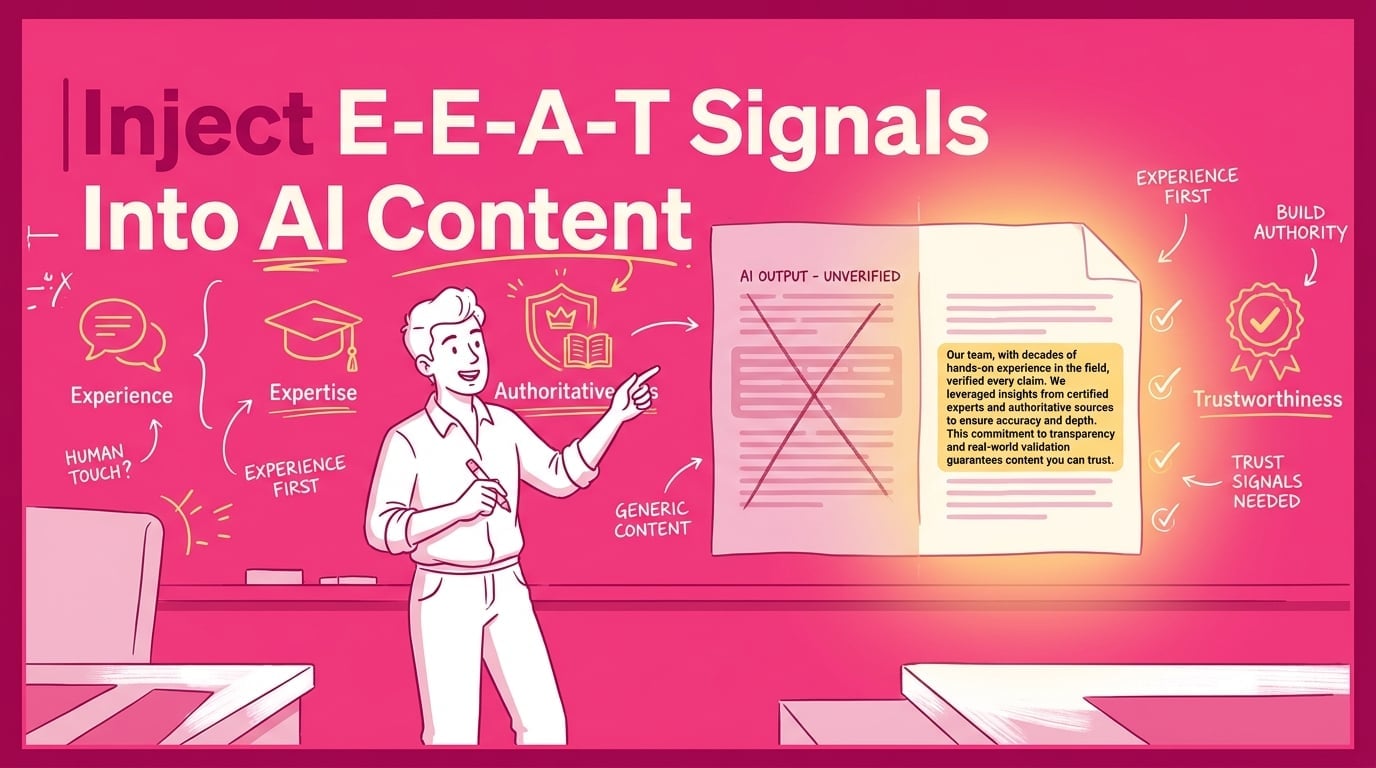
E-E-A-T SEO: How to Inject Trust Signals Manually into AI-Generated Content Using Human-in-the-Loop Editing
Most AI content advice tells you to write better prompts. That is the wrong problem to solve. The real gap is not what goes into the AI. It is what a human puts back in after the AI spits something out. Google has been explicit: it rewards content that demonstrates real experience, expertise, authoritativeness, and trustworthiness. An AI cannot fake any of those. You can.
What Are E-E-A-T Signals and Why Do They Matter for E-E-A-T SEO?
E-E-A-T signals are the four quality dimensions Google's search quality raters use to evaluate whether a page deserves to rank: Experience, Expertise, Authoritativeness, and Trustworthiness. Google's own documentation confirms raters are trained specifically to detect these signals.
Here is the uncomfortable truth. Organic search results account for about 94% of all clicks on SERPs, per Marketing LTB. That traffic goes to pages that earn trust. Generic AI drafts do not earn trust. They just fill space.
Where AI Falls Short: The Limits of Automated Content Quality
AI content quality refers to how well a piece of generated text meets accuracy, depth, and credibility standards without human correction. The ceiling is lower than most teams admit.
AI cannot cite a conversation it had with a customer last Tuesday. It cannot recall the product launch that flopped in Q3 2023. It cannot name the specific vendor that caused your team three weeks of pain. Those details are the entire point. Stratton Craig's QA guide for AI content puts it plainly: fact-checking and injecting real-world context are non-negotiable steps, not optional polish.
You are probably publishing AI drafts with a light proofread. That costs you ranking positions every single week.
How to Layer Human Experience onto AI Drafts for Stronger E-E-A-T SEO
Layering E-E-A-T signals means a human editor adds first-person experience, proprietary data, and named expert opinion directly into the AI draft before publishing. This is where the work actually happens.
Four things to add in every edit pass:
- A named anecdote. One specific story from your team or a named client. Not "a brand we worked with." A real company, a real result, a real timeframe.
- A proprietary data point. Internal survey, test result, or benchmark your team actually ran. AI cannot invent this. You can supply it.
- An expert quote. Full name, title, organization, and context. No anonymous sources.
- A trust marker. Author bio with credentials, publication date, last-reviewed date, and a disclosure where relevant.
Content with verifiable data earns roughly 30 to 40% more visibility in LLM-generated answers than purely qualitative content, according to ToTheWeb's GEO guide. That gap is yours to close with a single edit session.