Context Switching Freelancers: How It Destroys Creative Flow (and What to Do About It)
Context Switching Freelancers: How It Destroys Creative Flow (and What to Do About It)
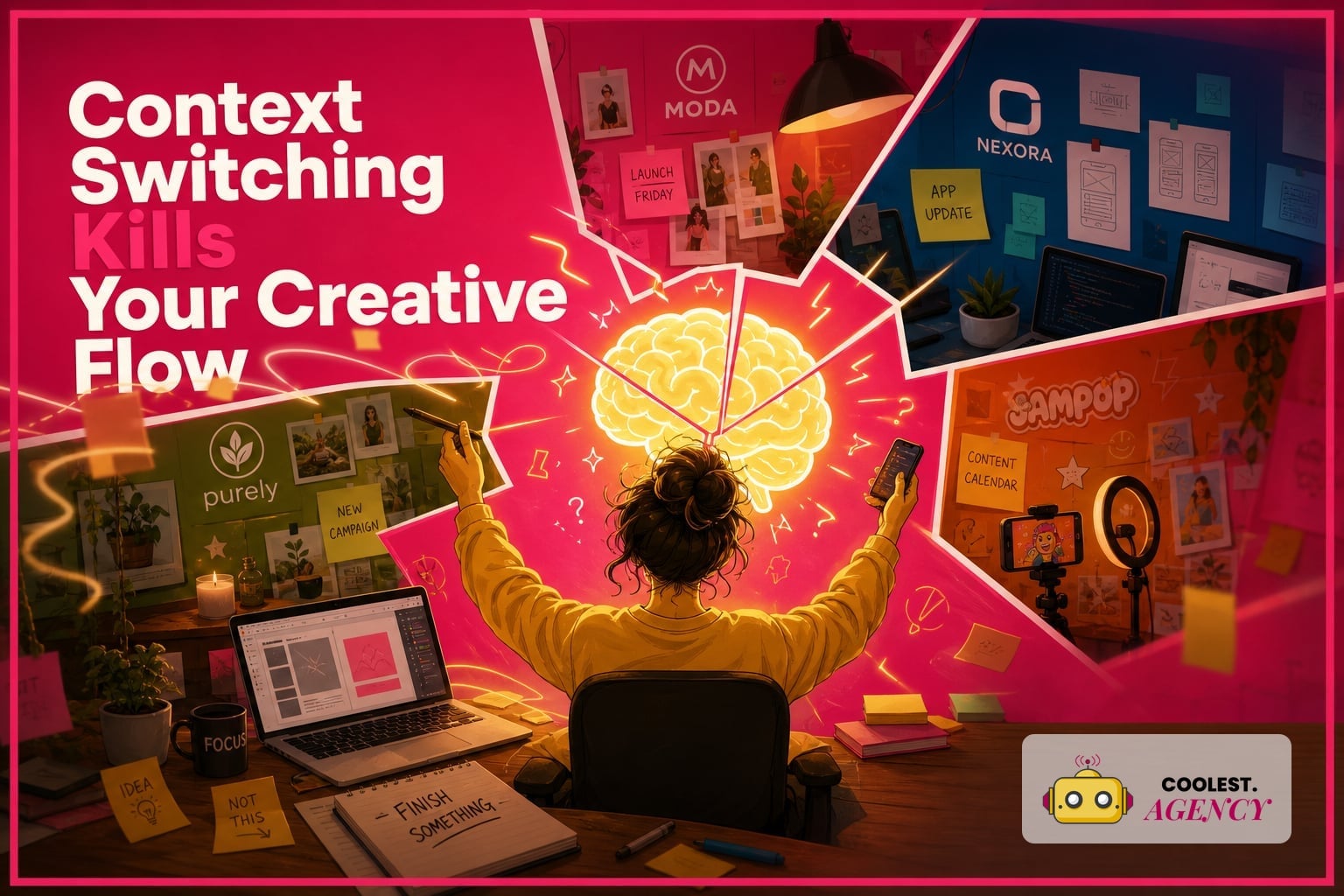
Context switching is the silent tax on every hour you work. Most freelancers blame deadlines, difficult clients, or too many projects. The real culprit is the invisible cost of bouncing between them. Every switch fragments your focus, kills your creative momentum, and quietly drains your income. Here is what is actually happening in your brain, and how to stop it.
- Context switching consumes up to 40% of your productive time, per Speakwise's 2026 research.
- Freelancers face 50% more digital interruptions than office workers.
- Each switch costs 15 to 25 minutes of recovery time, not seconds.
- The fix is structural: time-blocking, client batching, and smarter tools.
- You do not need more willpower. You need a different system.
Why Does Context Switching Hit Context Switching Freelancers Harder Than Anyone Else?
Context switching for freelancers means rapidly shifting mental focus between unrelated client projects, brand voices, and task types, often without any recovery time between them. It sounds like normal work. It is actually the fastest way to destroy a creative career.
A salaried employee switches between tasks inside one company, one brand, one set of goals. You switch between five completely different worlds. Morning might be a fintech startup that demands sharp, jargon-free copy. Afternoon is an emotional non-profit newsletter. Evening is an e-commerce brand screaming for conversion. Each switch forces your brain to discard one mental model and rebuild another from scratch.
Research cited by Tivazo shows freelancers working remotely face 50% more digital interruptions than office-bound counterparts. No physical boundaries means every Slack ping, email, and revision request lands directly in your lap, all day, every day.
Only 2.5% of people can genuinely multitask. For the other 97.5%, what feels like productive juggling is actually rapid task switching, and it is costing you real money, per Speakwise's 2026 context switching statistics.
Here is the part no one talks about: the problem compounds across clients. Each new project you add does not just add linear workload. It multiplies the number of mental context switches you make per day. Three clients means three brand voices, three sets of priorities, three different emotional registers. Five clients means chaos.
People experiencing attention residue after switching tasks are likely to demonstrate poor performance on that next task. The thicker the residue, the worse the performance.
Sophie Leroy, Professor of Management, University of Washington, in her peer-reviewed paper "Why Is It So Hard to Do My Work?"
How Context Switching Wrecks Creative Flow and Profit Margins
Creative flow is a distinct cognitive state where ideas connect faster, quality rises, and time disappears. It is the zone where your best freelance work actually gets made. Context switching kills it before it even starts.
Research published in PMC by NIH confirms that creative flow involves unconscious pattern-weaving and meaning-making that requires sustained, uninterrupted attention. The moment a Slack notification pulls you out, that thread snaps. Rebuilding it costs time you are not billing for.
Automate your entire content operation
Generate, publish, and track a month of posts on autopilot.
Start Free →
The financial damage is not abstract. A freelancer billing $75 per hour loses an estimated $9,000 annually just to context switching overhead, per Plurality Network's analysis. That number doubles to $18,000 if you are charging premium rates. That is a vacation, a new laptop, or a month of runway, gone.
You are probably losing time in two places you have not noticed yet. First, the re-briefing tax: every time you open a new client file, you spend 10 to 15 minutes mentally reloading their brand, their tone, their last conversation. Second, the quality dip: work produced mid-switch is measurably worse, which means more revisions, more client feedback rounds, and more unpaid hours.
Coolest.Agency addresses this directly. Its approach to social marketing automation learns your brand voice across clients and holds that context for you, so you are not rebuilding mental models from scratch every session. You set the plan, and the system stays aligned to it.
The creative cost is the one that stings most. Your best ideas do not show up on demand. They arrive when you are deep in a problem. Context switching ensures you never get deep enough for them to appear.
What Actually Works to Reduce Context Switching for Context Switching Freelancers?
Reducing context switching means designing your workday so your brain stays inside one mental model for as long as possible, using time structure, batching, and tool discipline to protect deep work blocks.
Most freelancer productivity advice stops at "use a to-do list." That is not enough. Here is a three-layer framework that actually moves the needle:
Layer 1: Client batching by day, not hour. Assign each client a dedicated day or half-day. Monday is Client A. Tuesday is Client B. You are not switching brands mid-morning. Your brain loads one context and stays there. Todoist's research on context switching confirms that fewer switches per day directly correlates with higher end-of-day output quality.
Layer 2: Kill the notification layer. Asana's 2025 report found that 56% of workers feel they must respond to notifications immediately. That is a trained reflex, not a requirement. Set two communication windows per day, 10am and 4pm. Everything else goes to voicemail, metaphorically.
Layer 3: Automate the re-briefing tax. The 10 to 15 minutes you spend re-explaining client context at the start of every session is pure waste. Tools that hold persistent brand context across sessions eliminate this entirely. Coolest.Agency's automation approach lets you set your social marketing plan once and lean back, instead of rebuilding it every Monday morning over a cold coffee.
Tivazo's cost analysis found that reducing interruptible activities by just 30% recovers 10% to 15% of total productivity. For a freelancer billing 30 hours a week, that is 3 to 4.5 hours back. Every single week.
The goal is not zero context switching. That is impossible. The goal is intentional switching, on your schedule, not your clients'.
Your Next Move (Take It Today, Not Next Monday)
Pick one client. Block a full half-day for them this week. Turn off all notifications during that block. Notice how different the work feels when your brain is not fighting itself. That is not a productivity hack. That is what your creative output was always supposed to feel like. Want to scale that across every client? Start there.