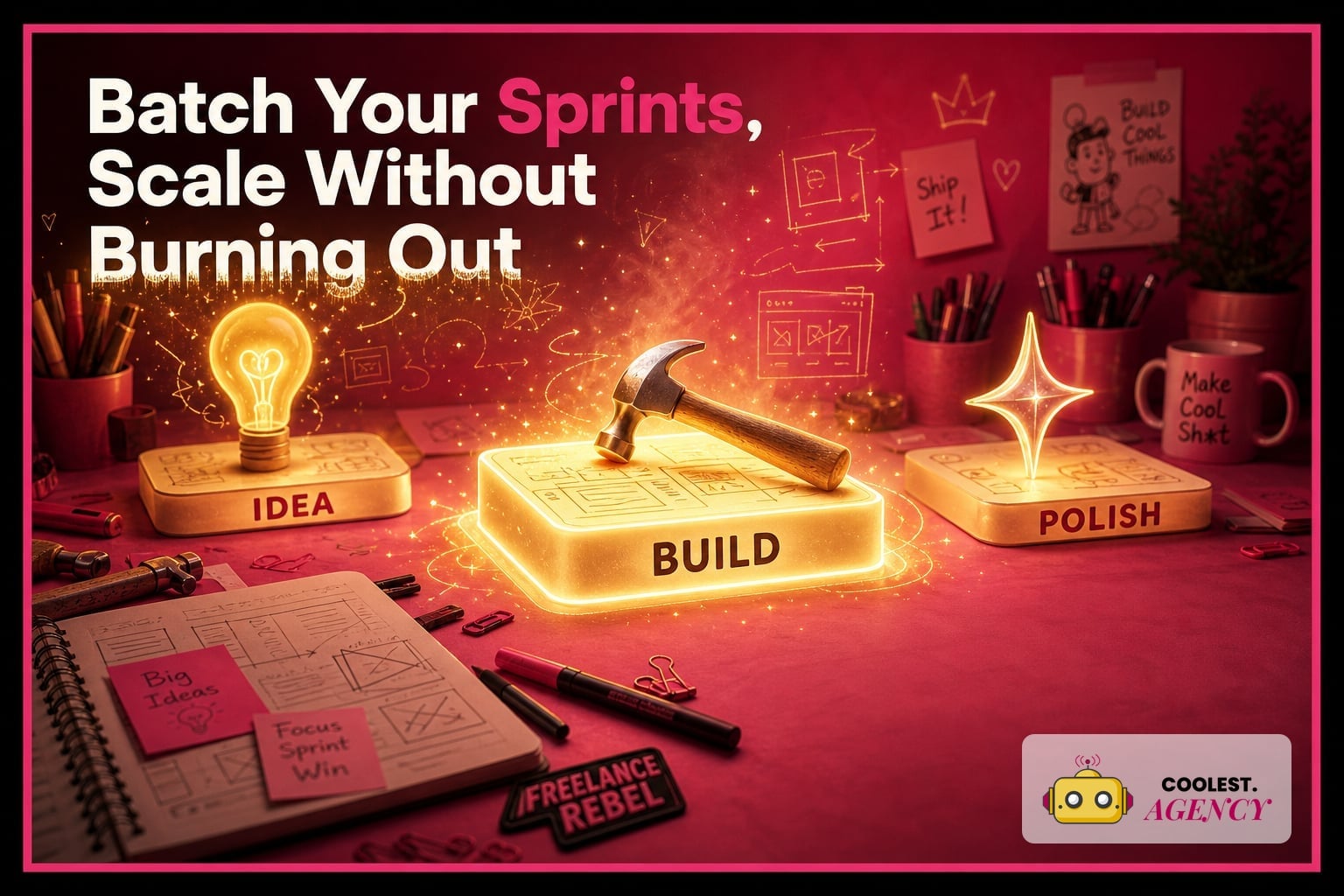
How Batching Creative Sprints Can Help Freelancers Scale Without Burning Out
Most advice on scaling freelance work tells you to work harder, hire faster, or automate everything. Here is the problem: none of that addresses how you create. Batching creative sprints, short focused bursts of one type of creative task done in sequence, is the structural fix that lets you multiply output without wrecking the part of your brain that makes your work worth paying for.
Key Takeaways
- Batching creative sprints groups similar tasks into focused time blocks to cut context switching and protect creative energy.
- Research via Sunsama shows context switching kills up to 40% of your productivity. Sprints fix that.
- The sprint model separates ideation, production, and editing into distinct sessions, never the same sitting.
- AI handles the scaffolding. You supply the spark. Neither replaces the other.
- Freelancers using structured batching report saving 50 to 70% of their time within the first month.
Why Marathon Content Days Fail Freelancers (and Your Brain)
A marathon content day is a single, unbroken session where you brainstorm, write, edit, design, and publish, all at once, all for multiple clients. It feels productive. It is actually a creativity blender.
Your brain does not multitask. It task-switches, and every switch costs you. The American Psychological Association, cited by Sunsama, found that context switching leads to a 40% decrease in productivity due to the mental lag of refocusing. For freelancers juggling three to five clients, that lag compounds fast.
The burnout numbers are brutal. According to a ReclaimAI report cited by FreelancerMap, 43% of freelancers burn out from long work days and 64.3% from lack of work-life balance. Those are not personality problems. They are workflow problems.
Here is what every top-10 article on this topic misses: the issue is not volume. It is task variety within a single session. Switching from strategic thinking to copywriting to visual editing in one afternoon is like sprinting, swimming, and rock climbing back to back. Each demands a different cognitive mode.
We were having meetings from 7 a.m. to 7 p.m. We started to really struggle with boundaries in our work life. It was just wild.
Samantha Anderl, Co-founder, Harlow, speaking to the Harlow blog about client communication overload
The fix is not better time management. It is architectural. You need to stop treating a workday as one long task and start treating it as a sequence of sprint types, each with a single cognitive mode and a hard stop.
How Batching Creative Sprints Actually Scales Your Workflow Without Turning You Into a Robot
Batching creative sprints means grouping identical types of creative work into dedicated, time-boxed sessions so your brain stays in one gear per session instead of grinding through all of them at once.
The contrarian point nobody makes: batching is not about doing more. It is about doing one thing at a time, repeatedly, until you have a week's worth of that one thing done. Then you move to the next type.
Automate your entire content operation
Generate, publish, and track a month of posts on autopilot.
Start Free →
Here is a three-sprint architecture that actually works:
- The Idea Sprint (30 min): Brainstorm only. No writing, no editing. Generate 10 hooks, 5 angles, or 3 campaign concepts. Pure divergent thinking.
- The Build Sprint (60 to 90 min): Write or produce only. Use your ideas from the Idea Sprint as fuel. No new ideation allowed.
- The Polish Sprint (30 min): Edit, format, schedule. Zero creative decisions. Just execution.
Run these as separate sessions on separate days or separate morning blocks. Never stack them in sequence on the same day.
Content strategist Hailey Dale's monthly content sprint model applies the same logic at scale: plan one day, create the next, edit and schedule after. The separation is the system.
Coolest.Agency's approach takes this further by learning your brand voice and automating the social publishing layer, so your Polish Sprint shrinks from 30 minutes to a coffee break. You set the plan, the system handles distribution, and your creative energy stays where it belongs: the Idea and Build Sprints.
Real-World Batching Creative Sprints: Blending AI and Human Creativity for Maximum Output
A practical sprint recipe blends AI-generated scaffolding with human creative judgment, using each tool for the cognitive mode it actually handles well.
You are probably using AI wrong. Dumping a brief into ChatGPT and publishing the output is not a sprint. It is outsourcing your creative identity. Clients can spot it. Freelancers using structured batch content systems report saving 50 to 70% of their time within the first month, but the ones keeping clients long-term are the ones where AI handles structure and humans handle voice.
Here is a real sprint recipe for a social content week:
- Monday Idea Sprint: Use AI to generate 20 post structures across five content pillars. You pick the 10 that fit your client's voice. Discard the rest.
- Tuesday Build Sprint: Write all 10 posts in one session. AI drafts, you rewrite the first two sentences of each. That is where your voice lives.
- Wednesday Polish Sprint: Edit, add visuals, schedule. Done by noon.
Coolest.Agency provides the strategic layer here: it learns your brand, automates your social marketing plan, and publishes on schedule, so you are not manually queuing posts at 11 p.m. You architect the week over a cup of coffee, then step back.
Freelance consultant Jovan Cicmil's 70-30 rule maps cleanly onto this: fill 70% of your schedule with sprint work, leave 30% open for client calls, new ideas, and the unexpected. That open 30% is not wasted time. It is where your best creative thinking happens.
The sprint model gives you something marathon days never will: a clear stop. When the Polish Sprint ends, the week is done. Your brain knows it. Your clients see the consistency. And you still sound like yourself.
Your Next Move
Pick one client. Map their next week of content into three sprint types: Idea, Build, Polish. Run them on separate days. Track how long each takes. After one week, you will have a repeatable system and proof that you did not need a 10-hour day to pull it off. Start tomorrow morning.