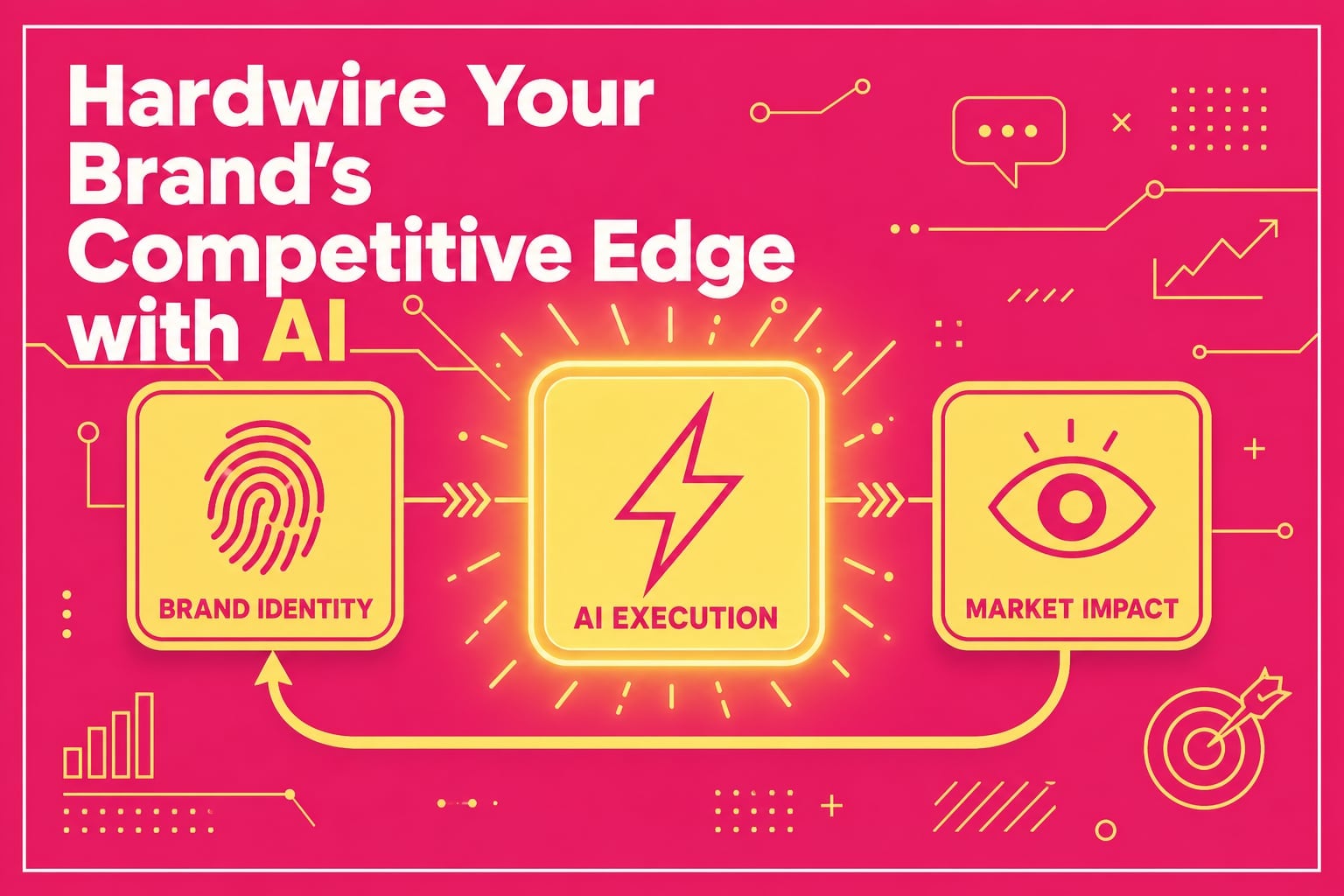
How AI Brand Strategy Can Hardwire Your Competitive Edge, No More Generic Tactics
Most AI brand strategy advice tells you to write better prompts. That is the wrong problem to solve. The real issue is that every brand is feeding the same tool the same instructions and getting the same beige output. The fix is not a smarter prompt. It is a deeper input: your brand's Digital DNA, hardwired into every AI move before a single word gets generated.
Key Takeaways: What AI Brand Strategy Actually Delivers
AI brand strategy is the practice of embedding a brand's core identity, values, and voice into AI systems so every output reinforces differentiation rather than diluting it.
Here is the uncomfortable truth: 87% of marketers now use AI in at least one workflow (Salesforce State of Marketing 2026). When everyone has the same tool, the tool is no longer the advantage. Your brand's irreplaceable specificity is.
The brands winning right now are not using AI to generate more content. They are using it to generate more of themselves, faster.
What Is Digital DNA in Branding and Why Does It Change Everything?
Digital DNA in branding is the full set of a brand's values, tone, emotional thresholds, and behavioral rules that make it recognizable across every channel and touchpoint.
Think of it as the difference between a costume and a skeleton. A prompt gives AI a costume. Digital DNA gives it a skeleton. Every brand has its own Digital DNA: a mix of tone, visuals, and subtle behaviors that make it feel alive online. The brands that encode this into their AI systems stop sounding like the internet's average and start sounding like themselves.
Your Digital DNA should define three things explicitly: what your brand will always say, what it will never say, and how it sounds when it is at its best. Without those three guardrails, every AI output is a coin flip.
How AI Brand Strategy Moves You Past Surface-Level Tactics
Strategic AI branding is the shift from using AI as a content generator to using it as a force multiplier for a pre-defined brand identity, where the brand's character shapes the output rather than the prompt alone.
Surface-level tactics look like this: you write a prompt, you get copy, you edit it, you post it. Rinse and repeat. The problem is that generative AI commoditizes past forms of advantage, making them more easily accessible to everyone (California Management Review, October 2024). Speed and volume are no longer differentiators.
The strategic move is to build a "personality architecture" before you open any AI tool. This means documenting your brand's motivation drivers, off-limits topics, and emotional range. Feed that architecture into every AI session. Now the tool is not generating generic content. It is generating your content at scale.
Automate your entire content operation
Generate, publish, and track a month of posts on autopilot.
Start Free →
Coolest.Agency's approach to this is built around exactly this principle: the platform learns your brand's voice and stays aligned to it across every social post it automates, so your output compounds your identity instead of averaging it out.
What a Human-in-the-Loop AI Brand Strategy Process Looks Like
A human-in-the-loop AI brand strategy process is a structured workflow where humans set the strategic direction, AI executes at scale, and humans validate outputs against brand standards before anything goes live.
Here is the practical sequence. First, a human defines the brand's Digital DNA and content boundaries. Second, AI drafts at speed. Third, a human reviews for tone, accuracy, and brand alignment. Fourth, approved content publishes. This is not AI replacing strategy. It is AI accelerating execution while humans protect the brand's soul.
Early Gen AI adopters report productivity and quality gains exceeding 40% (The Hackett Group, 2025). That number comes from integration, not experimentation. The brands hitting those gains have a human-in-the-loop process. The ones still experimenting are getting incremental bumps at best.
The biggest mistake we can make is thinking that this is just a story about technology. It's a story about humanity, and how AI will alter the fundamental nature of the human experience.
Jennifer Aaker, Professor of Marketing, Stanford Graduate School of Business, speaking via Stanford GSB Insights, April 2025
How to Set Ethical Boundaries for Safe, Authentic AI Brand Strategy
Ethical AI brand boundaries are explicit rules that define what topics, tones, and language patterns a brand's AI systems must avoid, protecting brand trust and preventing off-brand or harmful outputs.
You are probably skipping this step. That costs you every time an AI output sounds slightly off and a customer notices before you do. Build a strict playbook: list off-limits topics, flag tone patterns that conflict with your values, and define what "on-brand" looks like in concrete language, not abstract adjectives.
67% of consumers are influenced by online sentiment (Qualtrics, January 2026). One off-brand post does not just feel wrong. It moves a metric. Boundaries are not a creative constraint. They are a revenue protection mechanism.
Coolest.Agency provides a practical model here: set your social marketing plan once, let the platform publish in alignment with your brand voice, and review outputs against your boundaries rather than starting from scratch each time.
Your next step: Write down three things your brand will never say and three things it always sounds like. That is your first Digital DNA document. Everything else builds from there.