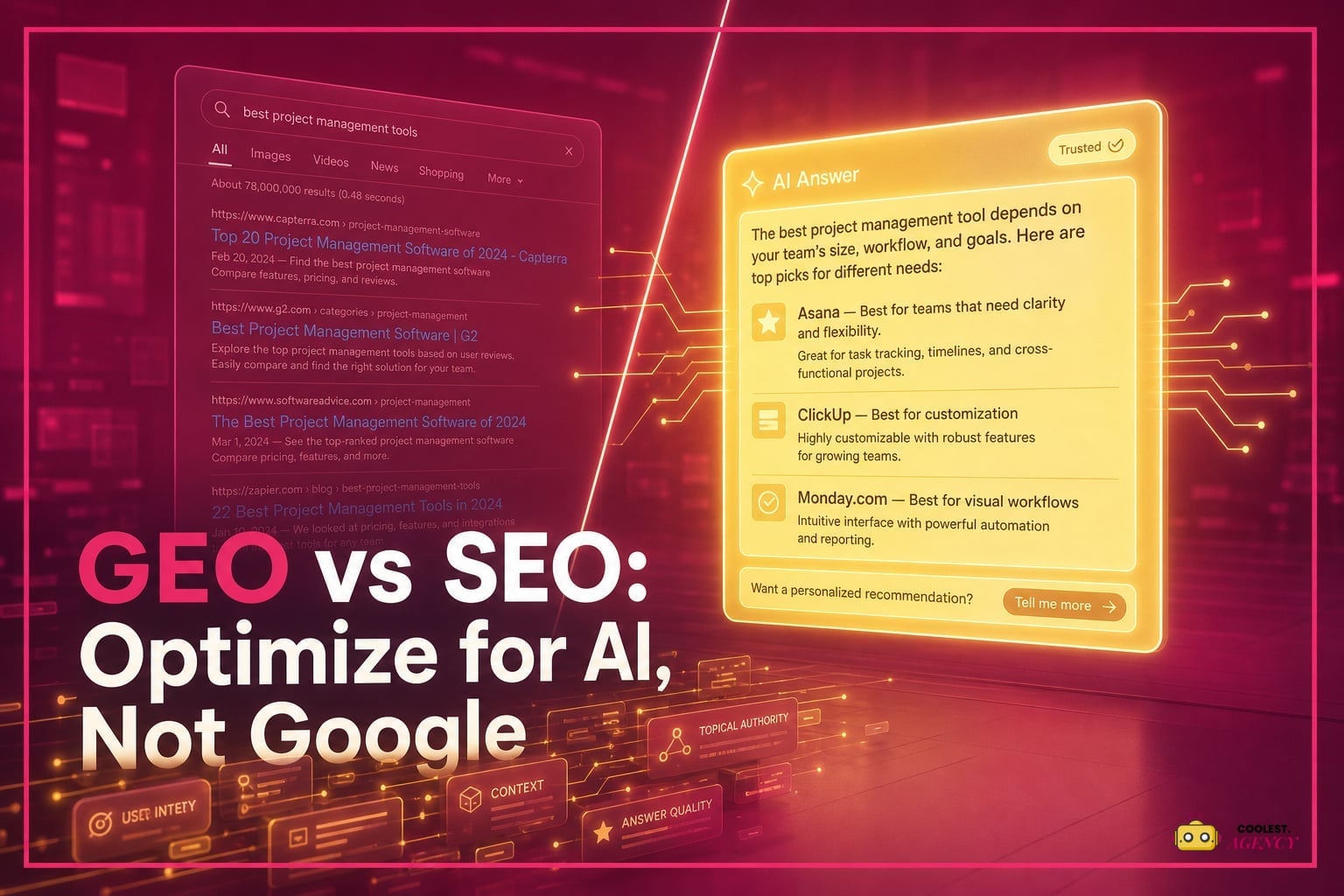
GEO vs SEO in the Age of AI: How to Optimize Content for ChatGPT Instead of Google
GEO (Generative Engine Optimization) is the practice of making your content the source AI models like ChatGPT choose when building their answers. SEO gets you a blue link. GEO gets you inside the answer itself. With 80% of consumers now relying on AI-written results for at least 40% of their searches, the two disciplines are no longer optional alternatives. You need both.
Key Takeaways: What's the Quick Answer on GEO vs SEO?
- SEO optimizes for ranking. GEO optimizes for selection by AI models.
- AI summaries cut click-through rates nearly in half compared to traditional search results.
- GEO success depends on third-party mentions, structured answers, and verifiable facts, not just backlinks.
- You do not have to choose one over the other. A dual strategy is the only strategy that holds up in 2026.
How Does GEO Actually Differ from Traditional SEO for AI Content Engines?
GEO vs SEO describes two fundamentally different games: SEO earns a ranked position in a list of links, while GEO earns inclusion inside a synthesized answer generated by an AI model.
Here is the uncomfortable truth most SEO guides skip. Your owned content may account for less than 10% of citation weight in AI-generated responses. As Daniel Martin explains on LinkedIn: "Earned mentions, reviews, forums, and third-party corroboration carry disproportionate influence. Repeated agreement across sources increases inclusion probability."
That changes everything about where you invest your time.
In traditional SEO, a well-optimized page on your own domain can rank at position one. In GEO, the AI is pulling from across the web. Your About page matters less than what industry blogs, Reddit threads, and review sites say about you.
PEW Research data cited by Ahrefs found that users click search results only 8% of the time when AI summaries appear, versus 15% without them. That is nearly 50% fewer clicks. And only 1% of users click the sources cited inside the AI summary itself.
The measurement model shifts too. SEO tracks keyword rankings and organic traffic. GEO tracks how often your brand appears in AI responses, at what position in the answer, and with what sentiment. Those are brand-new metrics most teams are not measuring yet.
SEO is about measuring clicks. GEO is about measuring visibility. The brands winning in AI search are the ones that show up consistently across sources, not just on their own site.
Zach Paruch, Content Strategist, Semrush, writing in GEO vs. SEO: A Comparative Guide for Digital Marketers, November 2025
What Does It Take to Optimize Content for ChatGPT and Other AI Models?
To optimize content for ChatGPT means structuring it so an AI model can extract a clean, citable answer without needing to paraphrase or interpret your intent.
Most brands are still writing for humans who scroll. ChatGPT does not scroll. It scans for extractable facts, clear definitions, and corroborated claims. If your content buries the answer in paragraph five, the AI skips you entirely.
Three things AI models consistently prefer, according to Ahrefs' GEO research:
- How-to guides and comparison pages. "X vs Y" formats and step-by-step answers get the highest AI citation rates.
- Specific, verifiable numbers. AI models cite data points they can attribute. Vague claims get ignored.
- Third-party mentions. Reviews, "best of" lists, and forum discussions carry more citation weight than your own homepage.