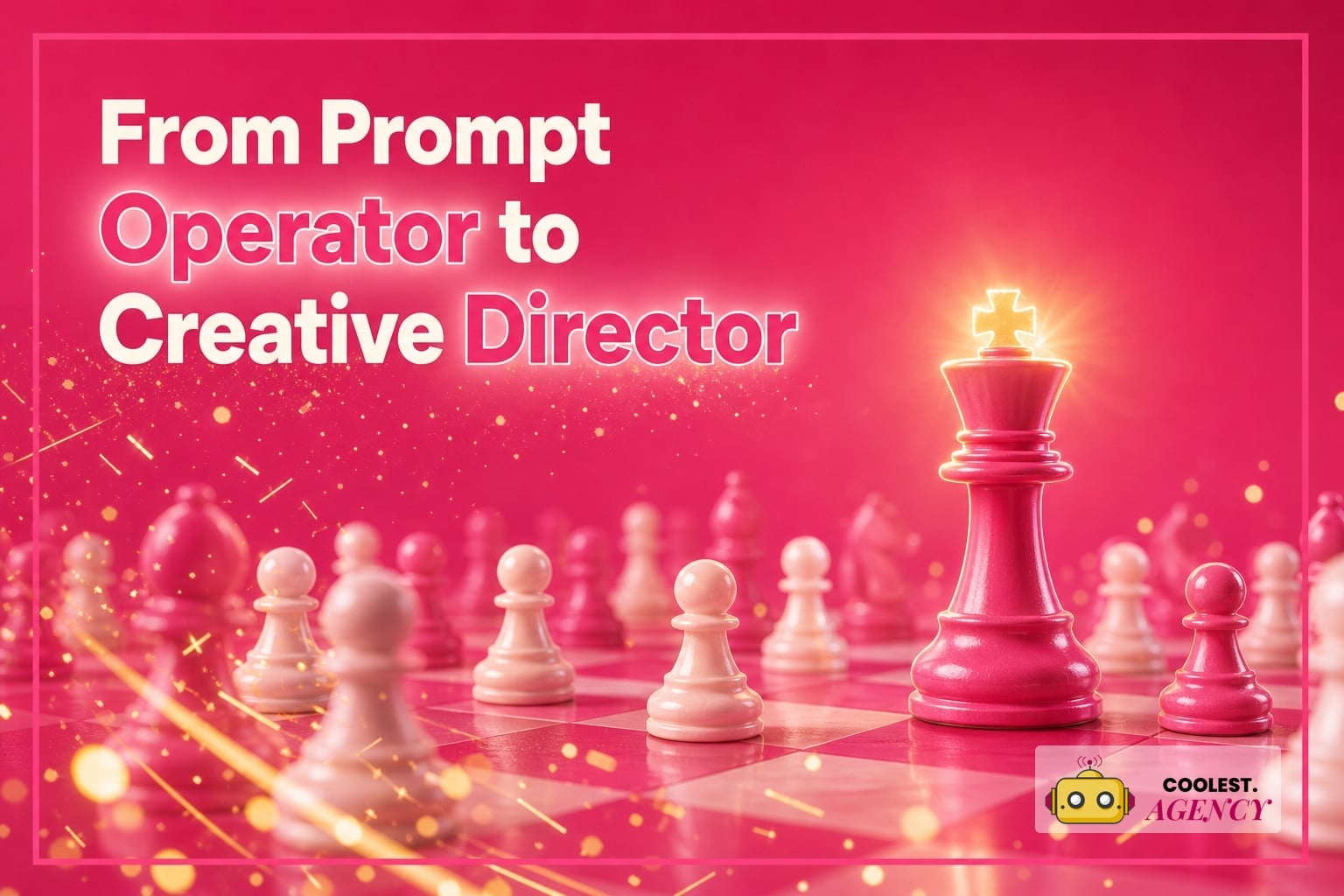
The Freelancer's Promotion Nobody Announced: From Prompt Operator to Creative Director
The freelancer to agency leader jump is a promotion nobody announced. It is the tenth client of the day, the blank cursor, and the client asking why they should pay you if ChatGPT is free. Your answer is a title change: stop producing drafts, start directing them.
Key Takeaways
- Senior AI creative director roles post at $180,000-$240,000 a year, because judgment is the scarce asset.
- Freelancers using AI save 8.1 hours a week, but only directors spend those hours on strategy instead of more drafts.
- Taste, strategic framing, and client insight form the three-part stack that separates you from a prompt operator.
- Count your last ten deliverables as "executed" or "directed." That ratio is your real seniority.
What Does a Creative Director Actually Do in the Age of AI?
A creative director sets the idea, the standard, and the strategic direction, then judges every output against them. With AI, you move from producing first drafts to deciding which ideas deserve to exist.
Picture 4 p.m. You have generated forty captions for a logistics client. Thirty-nine are fine. Fine is the problem. The operator posts one. The director asks what the client's category is afraid to say, and rewrites the brief.
The market already prices this split. A Valid AI Creative Director listing offers $180,000-$240,000 a year for someone who knows what the client needs, not just what they asked for. Even the lower band, $88k-$153k on ZipRecruiter, pays for oversight, not output.
Think Grandmaster Chess. The engine calculates every line. The Grandmaster decides which game is worth playing. You are choosing the game.
Which Skills Separate a Creative Director from a Prompt Operator?
Three skills make the difference: taste (curation), strategic framing (the brief behind the prompt), and client insight. Each one compounds as AI output gets cheaper and more generic.
Here is the contrast. The operator types "write a LinkedIn post about logistics." The director writes a brief: audience, enemy, tension, proof, and a Swiss Watch analogy that makes freight feel like precision engineering. Same model. Different league.