← Back to blog
human taste vs AIlimits of AI creativitycreative legacy in AI agehuman skills AI cannot replacepost-generic AI

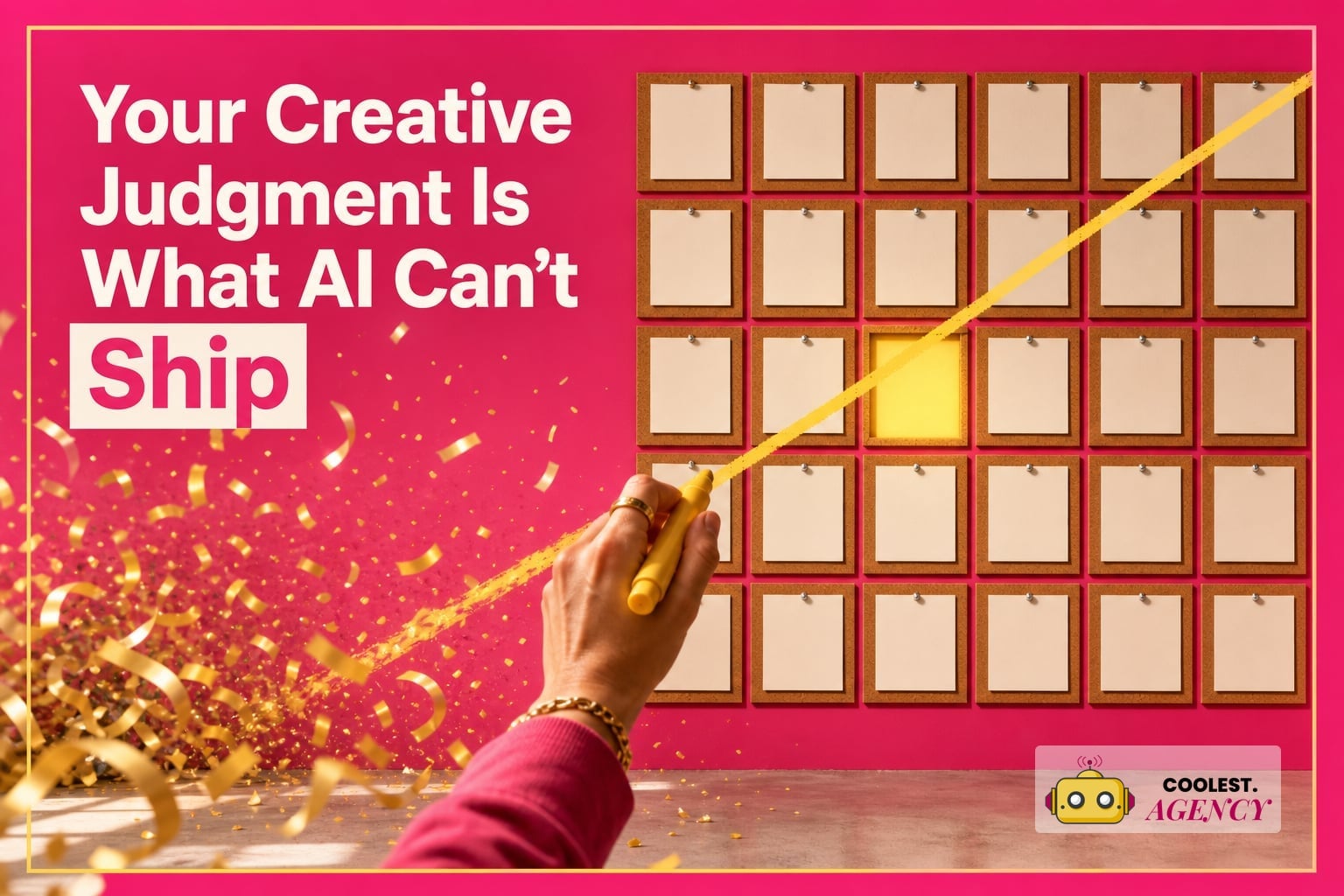
Your Creative Judgment Is the Only Part of Your Legacy AI Can't Ship

E

· 27 October 2026 · 5 min read

Your Creative Judgment Is the Only Part of Your Legacy AI Can't Ship

Your Creative Judgment Is the Only Part of Your Legacy AI Can't Ship

Creative judgment AI era: it is the discipline of deciding what deserves to exist, and it is the one input your competitors cannot generate at the same speed you can. I will argue something sharper. Taste is trained by refusals, so your legacy is the pattern of what you kill.

Key Takeaways

  • Only 6% of AI-generated ideas were unique, against 100% from humans working alone (Wharton). Selection, not generation, is where you win.
  • Three judgment skills hold up: cultural reading, deciding why a piece exists, and cutting a competent draft.
  • Your refusals compound. Years of consistent "no" decisions form a body of work no prompt can backfill.
  • AI is a strategic partner when you hold the final cut.

Why Does AI Hit a Ceiling When the Brief Is Taste?

AI predicts the likeliest next output from average data, so it converges on the generic. Taste is the deliberate departure from average, and that decision still belongs to you.

You have felt this. Your drafts arrive in seconds, polished, and strangely interchangeable with the agency down the street.

The numbers explain the feeling. In a Wharton study, just 6% of AI-generated ideas were considered unique, compared with 100% in the human group. Researcher Lennart Meincke put the mechanism plainly: given the same prompt, the model tries to average the most likely completions.

It gets stranger at the edges. In a controlled aesthetic test, Microsoft Copilot chose the same image in 96 to 100 percent of runs in every test, regardless of content. That is not taste. That is a reflex.

Here is the contrast I care about. Execution is now cheap and abundant. Selection is scarce and priced accordingly. As one analysis puts it, when plausible answers become abundant, disciplined human judgment becomes the scarce advantage.

Which Human Skills Can AI Not Replace in Creative Work?

Three skills hold up: cultural reading, the ability to decide why a piece should exist, and the nerve to cut a competent draft. Each is judgment, not production.

Here is my ranking, by how much margin each one protects.

1. The nerve to cut a competent draft

This ranks first because it is the rarest. Competent is the trap. AI hands you ten competent drafts, and the pull to ship one is enormous. Taste, as one writer frames it, involves selective restraint and the ability to see what should be removed rather than added.

Automate your entire content operation

Generate, publish, and track a month of posts on autopilot.

Start Free →

2. Deciding why a piece should exist

A model can answer a brief. It cannot question whether the brief deserves an answer. That "why" is purpose, and purpose is a human act.

3. Cultural reading

You sense a shift before it shows up in training data. AI approximates popularity. You anticipate what comes next.

Now the honest counterargument. One 2026 vendor report claims AI predicts creative success with over 90% accuracy, against 52% for human judgment alone. Fair. Use it. A predictor tells you what will perform like the past. It cannot tell you what your body of work should stand for.

How Do Your Refusals Become a Legacy?

The drafts you reject, repeated for years, form a recognizable body of work. That pattern is your legacy, and no prompt can backfill it.

Picture two studios in 2028. Both ship at AI speed. One ships everything that clears a quality bar. The other kills nine of ten drafts for reasons it can name. Clients can describe the second studio in a sentence. They cannot describe the first at all.

Think of a Swiss watchmaker. The value is not in the parts, which any workshop can cast. It is in the thousand rejected tolerances. AI hands you endless parts. You supply the tolerances.

The strategic partner model works the same way. Let the machine generate the volume, then act as the Grandmaster who decides which moves the game will remember. Even simplicity is a choice: in the same Otterly test, people leaned toward simplicity, choosing it 59 percent of the time, and nobody can tell you which simple version is yours.

My own lesson came from fifteen-plus years in marketing, the experience our co-founder Elad Gaon brings to Coolest.Agency. The work people remembered was never the cleanest draft. It was the one where we said no to the safe version and could explain why.

My prediction for your next two years: clients will stop paying for output and start paying for the editor behind it. Start keeping a refusal log. One line per rejected draft, with the reason. In a year, it reads like your style guide.

Take one AI draft from this week, cut it down to the single line only you would have written, and tell us what you kept. Follow along if you want more takes like this.

Ready to put your marketing on autopilot?

Join teams that ship more content in a week than most do in a month.

Get Started Free →

Automate your content

Start Free →

We use essential cookies to run Coolest.Agency and, with your permission, analytics and advertising cookies to improve it and measure our campaigns. Learn more.