← Back to blog
selective amplificationcross-posting ROIamplification vs cross-postingcontent amplification strategyplatform fatigue

The Content Distribution Debate That's Costing Marketers Real ROI: Selective Amplification vs. Cross-Posting

E

· 20 September 2026 · 5 min read

The Content Distribution Debate That's Costing Marketers Real ROI: Selective Amplification vs. Cross-Posting

The Content Distribution Debate That's Costing Marketers Real ROI: Selective Amplification vs. Cross-Posting

Here's the uncomfortable math nobody in your content calendar wants to run: every platform you cross-post to without a plan is quietly taxing your content distribution ROI, not multiplying it. You're posting to five feeds and getting the algorithmic cold shoulder from four of them. Selective amplification, focused push on the one or two channels where your audience actually lives, routinely beats the scattershot approach because depth of resonance beats breadth of presence in a feed that's already drowning in noise.

Key Takeaways

  • Cross-posting inflates apparent reach while suppressing real engagement, because platform algorithms actively penalize duplicate content across channels.
  • Content marketing overall delivers $42 in ROI per $1 spent, per Revenue Memo's 2026 analysis, but that return concentrates hardest where distribution is focused, not spread thin.
  • Selective amplification compounds: the same channel, fed consistently, builds algorithmic trust that cross-posting resets with every duplicate post.
  • 87% of marketers plan to expand to more networks this year, per Sprout Social's 2026 report, which means most of your competitors are about to make this mistake at scale.
  • Your goal, not your habit, should decide the method: depth for authority, breadth only for time-boxed announcements.

What Cross-Posting Actually Does to Your Content's ROI

Cross-posting to multiple platforms simultaneously inflates your apparent reach while suppressing per-platform engagement, because algorithms penalize identical content and audiences tune out repetition. That's the metric killer nobody puts on the dashboard: your reach number goes up, your ROI number quietly goes down.

Here's the part that should sting. 87% of marketers plan to expand onto more networks this year, according to Sprout Social's 2026 Social Media Content Strategy report. Almost everyone is doubling down on the exact habit that dilutes them.

Meanwhile, Brandwatch's glossary breakdown is blunt about the mechanism: most cross-posting failures come from treating distribution as copy-and-paste instead of adapt-and-distribute, since each platform runs different character limits, aspect ratios, and reach behavior for links.

You already feel the symptom, even if you haven't named it: engagement per post creeping down as your posting volume creeps up. That's creative fatigue before performance drops, and it shows up long before your reporting dashboard admits it. Cross-posting doesn't just fail to add reach. It actively erodes the signal your best content already earned.

How Selective Amplification Compounds Returns Over Time

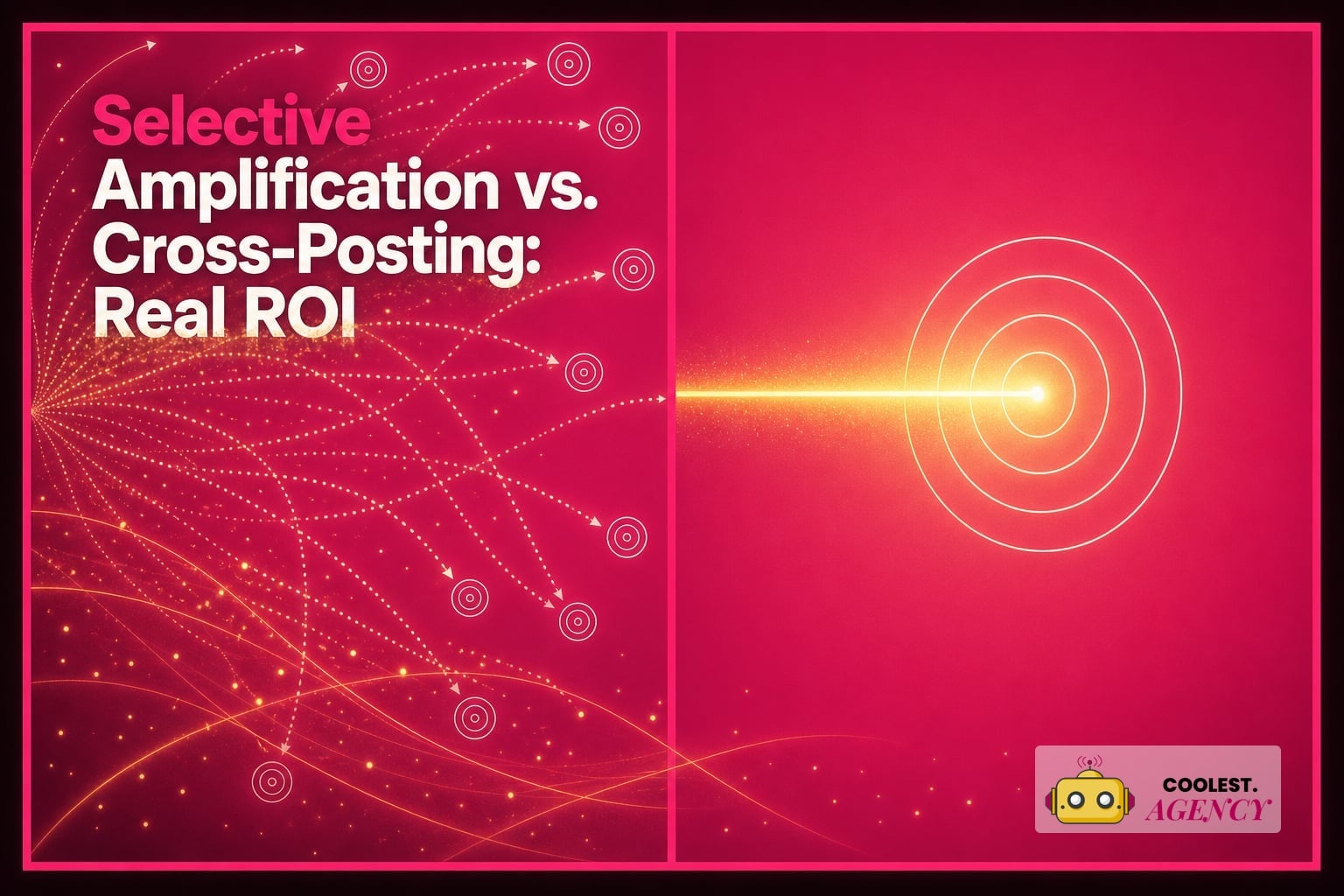
Selective amplification on one or two well-matched channels builds algorithmic momentum and audience trust simultaneously, producing engagement that compounds instead of resetting with every new post. Think of cross-posting as five weak radio signals fighting static. Selective amplification is one laser, aimed, focused, cutting straight through.

Automate your entire content operation

Generate, publish, and track a month of posts on autopilot.

Start Free

AMT's research on amplification frames it as turning a single post into a scalable distribution engine, extending reach through algorithmic signal and resharing rather than manufacturing five separate weak signals from scratch.

Content marketing returns an average of $3 per dollar compared to just $1.80 for paid advertising, a 67% performance advantage, according to Revenue Memo's 2026 content marketing ROI analysis.

That gap widens further when distribution is focused. Brandwatch notes cross-posting sits in a "low effort, maximize reach with limited resources" middle ground. Selective amplification skips that trade entirely: it spends effort where the audience already exists, so trust compounds instead of resetting.

This is where operators managing 3 to 5 clients hit a real ceiling: you can't hand-tune five platforms per client without burning your week. Coolest.Agency offers automated social publishing that learns a brand and stays aligned to it, so the focused-channel play doesn't require you to babysit every post yourself. And how one campaign pays for your entire month of content is the exact logic that makes concentrated distribution defensible to a client who's watching the invoice.

Choosing the Right Distribution Method for Your Content Goals

Choose selective amplification when your goal is engagement depth, brand authority, or lead quality. Reserve cross-posting only for time-boxed announcements where raw reach in a short window outweighs sustained resonance, a product launch date, a live event, a deadline.

Picture a client asking for "more visibility everywhere." That's the trap. Visibility everywhere is dilution wearing a nice suit. Ask instead: where does this specific audience already pay attention, and what does winning that one channel actually pay back?

AMT and Brandwatch both point to the same filter: match the content's format and tone to the platform's native behavior before you decide how many platforms deserve it at all.

Run the numbers before you commit either way. the metrics that actually predict conversions will tell you faster than gut feel whether depth or breadth is winning for a given client, and agency-scale content without the burnout shows how to run this decision without adding a headcount.

If you want a second set of eyes architecting the actual distribution plan, so each post lands on the channel built to convert it, that's precisely what a human Content Strategist does.

Ready to put your marketing on autopilot?

Join teams that ship more content in a week than most do in a month.

Get Started Free

Automate your content

Start Free

We use essential cookies to run Coolest.Agency and, with your permission, analytics and advertising cookies to improve it and measure our campaigns. Learn more.