← Back to blog
attention leak frameworkfix audience attention leakscontent engagement optimizationaudience attention dropcontent performance diagnostic

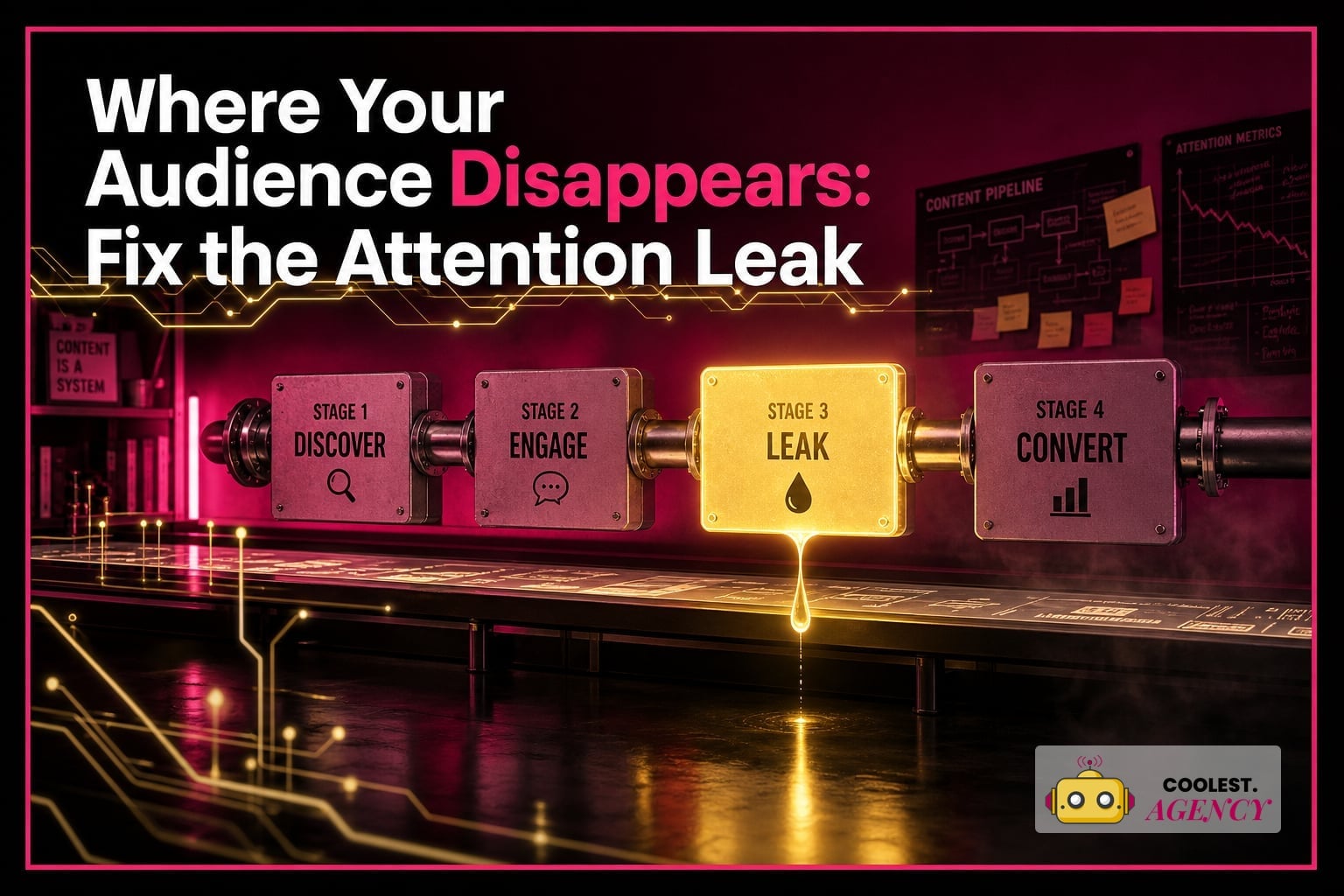
Where Your Audience Actually Disappears: A Four-Stage Framework for Diagnosing Attention Leaks

E

· 28 September 2026 · 4 min read

Where Your Audience Actually Disappears: A Four-Stage Framework for Diagnosing Attention Leaks

Where Your Audience Actually Disappears: A Four-Stage Framework for Diagnosing Attention Leaks

Good reach, flat results? You are not bad at content. You are blind to your content attention stages, the four checkpoints (Impression, Stop, Consume, Act) every post must clear before it pays off, and somewhere in that pipeline your audience is quietly walking out the door.

Key Takeaways

  • Four gates, one leak: Impression, Stop, Consume, and Act each fail differently, so "more content" almost never fixes the actual problem.
  • 85% of a knowledge worker's day gets eaten by shallow, fragmented activity, per Speakwise's 2026 report, which means your Stop gate is fighting harder than you think.
  • Short-form clips can drive strong engagement numbers while leaving brand recall surprisingly low, proof that Consume-stage wins can still lose the war.
  • Fix the earliest broken gate first. Repairing Act while Stop is broken wastes every dollar spent upstream.

The Four Content Attention Stages and What Each One Tells You

Impression, Stop, Consume, and Act are four sequential gates your content must pass. A drop at any one gate tells you exactly where your audience walked away and why.

Here is the contrast nobody puts in a dashboard: reach measures Gate 1. Almost every social manager treats it as the whole scoreboard. It is one line of a four-line ledger.

Impression is simply the algorithm putting your post in front of an eyeball, tracked on LinkedIn and Facebook as reach or impressions. Stop is the scroll-thumb freezing mid-motion. Consume is the reader actually taking in your message, not just glancing past it. Act is the click, comment, save, or purchase that proves the message landed hard enough to move a hand.

Each gate has its own physics. You cannot brute-force Stop by fixing Consume, and you cannot buy your way past Act with more Impressions. That is the mistake burning your budget right now: treating a four-stage pipeline like a single dial.

How to Retain Audience Attention Across Each Stage

Each stage leaks for a different reason: Impression fails on context mismatch, Stop fails on a weak hook, Consume fails on buried value, and Act fails on a vague or missing next step.

The numbers back this up, and they are brutal. A one-hour scroll session cuts a viewer's sustained attention by 25% for up to two hours afterward, per Worldmetrics' 2026 research. Your post is not competing with your competitor. It is competing with a fried nervous system.

Automate your entire content operation

Generate, publish, and track a month of posts on autopilot.

Start Free →

Run the diagnostic like a detective, not a cheerleader. Symptom: impressions are fine, but nobody stops. Root cause: your hook reads like a caption, not a hostage negotiation. Signal: check your first-second retention on video, first-line click on text.

Symptom: people stop, then bounce fast. Root cause: you buried the payoff under three paragraphs of throat-clearing. Signal: watch average watch time and scroll depth, not likes.

Symptom: strong watch time, zero clicks or saves. Root cause: no next step, or five competing ones. Signal: compare comments-asking-questions against comments-taking-action.

Coolest.Agency's approach treats this as a diagnostic problem before a production problem: the brand learns your tone and flags which gate a given post is actually failing at, rather than assuming volume is the fix. Notification spikes push attention up 30%, but Worldmetrics also finds 60% of users feel mentally drained afterward, so a louder hook alone can win Stop and still lose Act.

Fixing the Right Stage: A Prioritized Repair Sequence

Always fix the earliest leaking stage first. Patching Act while Stop is broken is like repainting a house with a cracked foundation: it looks good in photos until the wall moves.

Picture two agencies. Both post daily. One spends March rewriting call-to-action copy while their hook is still losing 90% of scrollers in the first second. The other checks Stop first, fixes the hook, and only then touches the CTA. Guess which one's ROI measurement framework shows movement by month two.

The repair order: Impression (targeting and timing) before Stop (the hook) before Consume (pacing and payoff) before Act (the ask). Skipping ahead just relocates the leak.

Before you touch anything, watch for creative fatigue before your numbers move, because a fatigued format mimics a Stop-stage leak and sends you fixing the wrong gate entirely.

Diagnosing this by hand every week is a real job, and most small teams do not have a spare analyst sitting around. That is the case for a systematic workflow over ad hoc guessing, and it is also where the right metrics that predict conversions earn their keep instead of vanity numbers.

See how a Content Strategist architects your content plan around the stage that is actually leaking, so you stop guessing and start fixing the right thing.

Ready to put your marketing on autopilot?

Join teams that ship more content in a week than most do in a month.

Get Started Free →

Automate your content

Start Free →

We use essential cookies to run Coolest.Agency and, with your permission, analytics and advertising cookies to improve it and measure our campaigns. Learn more.