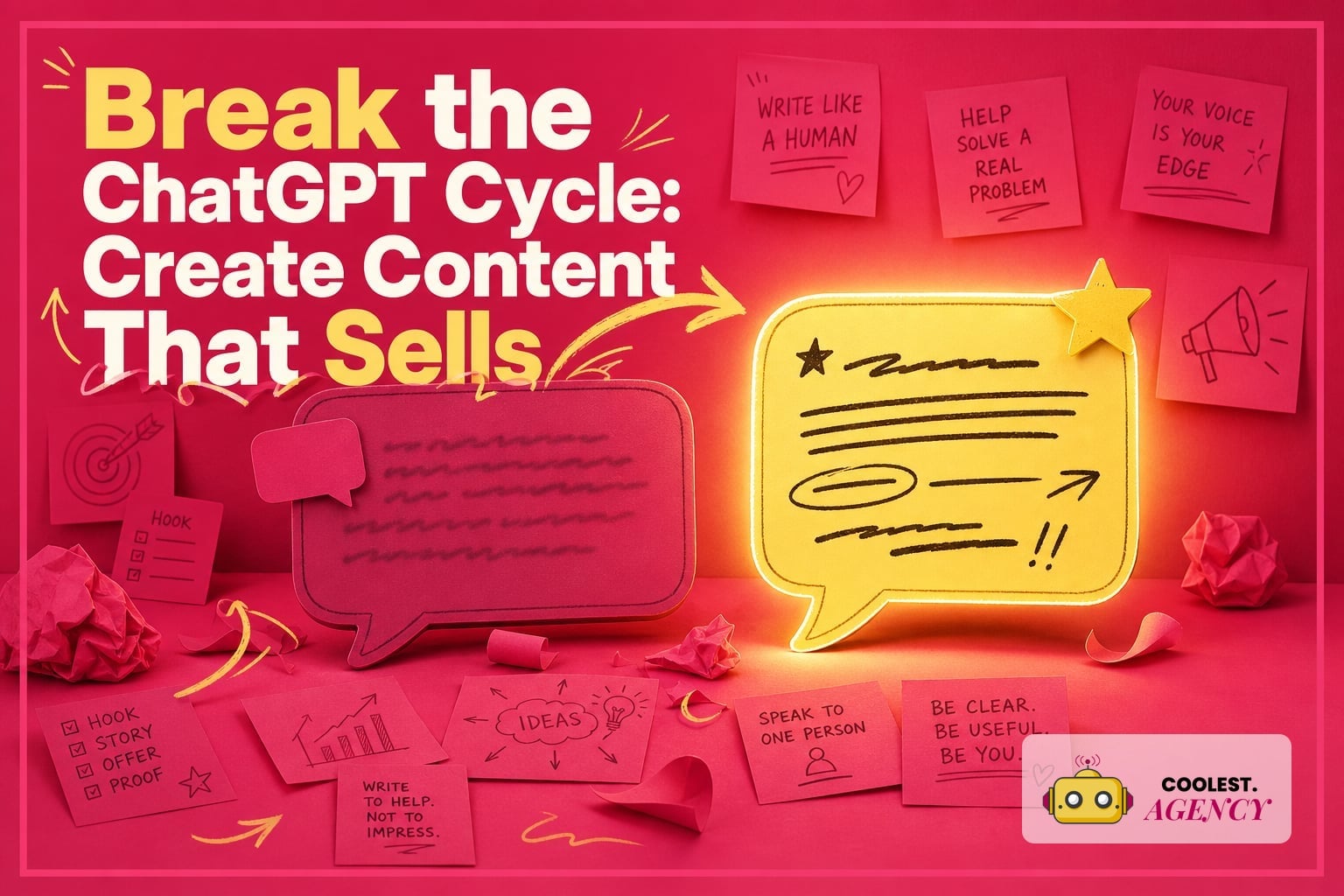
Breaking ChatGPT Dependency: How to Create Unique Content That Actually Sells
Most freelance content today is forgettable before the reader finishes the first paragraph. Not because the writer lacks talent, but because they handed the wheel to a tool that predicts the internet's average output. According to Buzzsumo's 2024 Content Analysis, 87% of content creators now use AI assistance, but only 13% produce content that generates meaningful engagement and business results. The gap is not the tool. It is the strategy behind it.
Key Takeaways
- AI-speak is real, clients spot it instantly, and it is killing conversion rates.
- The fix is not less AI. It is smarter inputs: your opinions, your data, your narrative.
- Strategic reasoning turns AI from a ghostwriter into a launchpad.
- Narrative-driven content outperforms generic output because it is irreplaceable by any prompt.
- Breaking ChatGPT dependency is a competitive advantage in 2026, not a nice-to-have.
Why Breaking ChatGPT Dependency Matters for Freelancers in 2026
Breaking ChatGPT dependency means moving from passive AI consumption to active strategic direction, where you supply the angle, the voice, and the argument that no prompt can generate alone.
Here is the uncomfortable truth: 900 million people use ChatGPT every week as of May 2026. Your client is using it. Their competitor is using it. Their competitor's intern is using it. When everyone runs the same tool on the same brief, the output converges. Clients are not buying words anymore. They are buying a point of view they cannot get from a chatbot.
The freelancers still winning retainers are not the ones who type faster. They are the ones who show up with a thesis, a narrative arc, and an argument the client has never heard before. That is the product now.
In 2023, knowing how to use AI was a competitive edge. In 2026, it is table stakes. Conductor's 2026 State of AEO research found that 97% of CMOs reported AI visibility had a positive impact on their marketing funnel in 2025, reinforcing that structured, credible content wins. Generic does not rank. Generic does not convert. Generic does not get referred.
You are either the freelancer who uses AI to scale your expertise, or the one AI is slowly replacing. The difference is one decision: who is doing the thinking?
How to Spot and Break Free from AI-Speak in Your Content
AI-speak is the pattern of vague, hedge-everything language that emerges when a model generates content without a strong human input: phrases like "in today's fast-paced world," "it is important to note," and advice so broad it applies to every industry simultaneously.
You probably recognize it when you read it. The harder question is whether you recognize it in your own drafts. Run this test: remove your client's brand name from a piece you wrote last month. Could it belong to any competitor? If yes, it is AI-speak, and your client will feel that, even if they cannot name it.
SEO strategist Matt Diggity identifies three root causes of generic AI content: weak inputs, vague prompts, and zero human editing. Fix those three, and the tool becomes useful. Leave them broken, and you are just an expensive copy-paste operator.