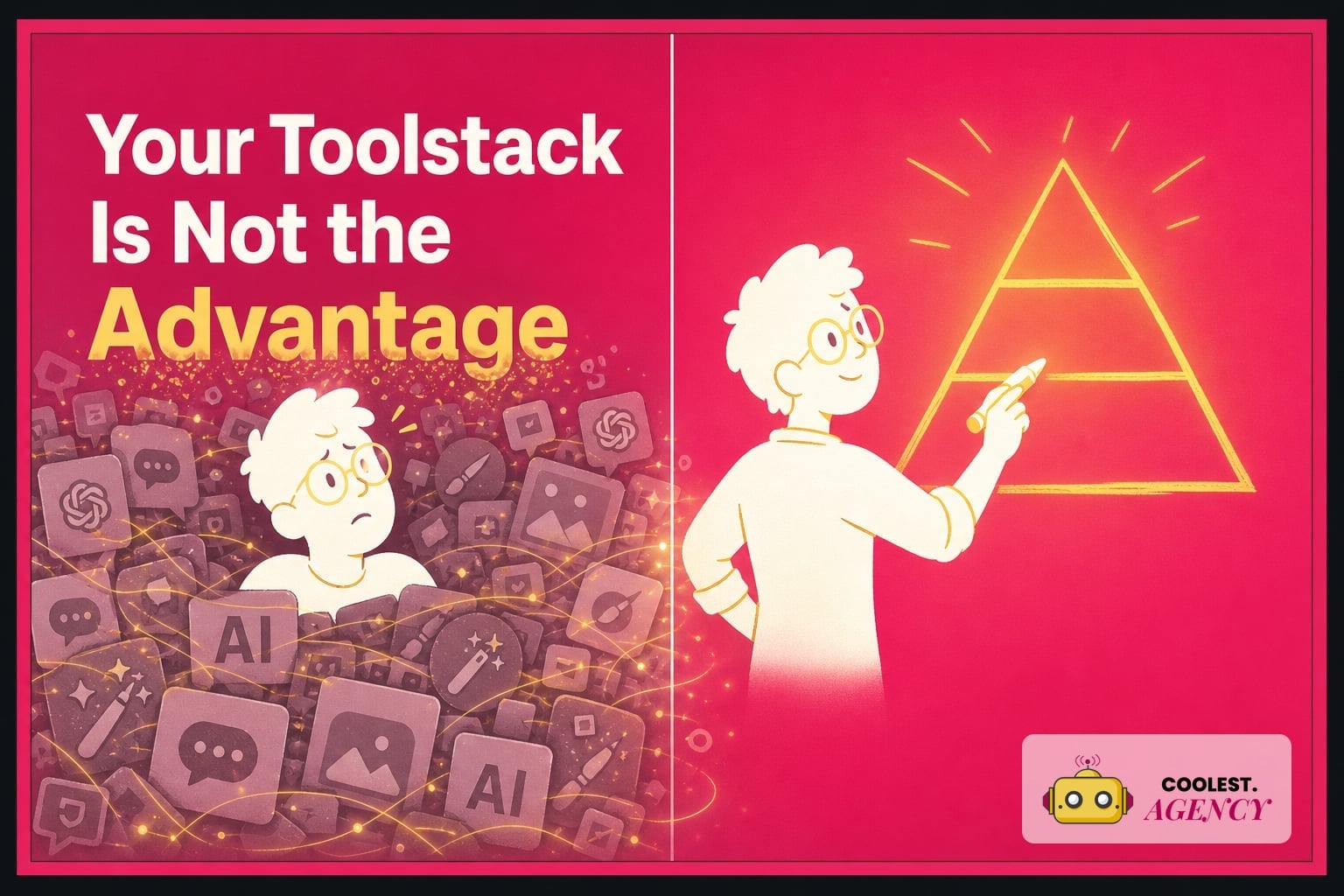
AI Strategy for Freelancers: Why Your Toolstack Is Not the Advantage You Think It Is
In 2026, every freelancer has ChatGPT. Most have Midjourney, Canva AI, and a prompt library they are quietly proud of. And yet, most of them are losing clients to competitors with the exact same tools. The real differentiator is not what you use. It is the strategic reasoning layer sitting above those tools. That is the gap this article closes.
Key Takeaways
- AI tool access is now table stakes. Strategy is the moat.
- The "tool trap" is real: better prompts do not fix a positioning problem.
- A premium AI strategy has three layers: positioning narrative, conversion-trained reasoning, and measurable outcomes.
- Freelancers who build the strategy layer command higher fees and repeat retainers.
- The next step is not a new tool. It is a new framework.
The Post-Generic AI Era: Why Everyone Having the Same Tools Is Your Biggest Problem
The post-generic AI era is the current market phase where AI tool access is universal, which means tool ownership no longer signals skill, speed, or quality to clients. When every freelancer uses the same AI tools, the tools stop being an advantage. Your strategy becomes the only real differentiator.
Here is the contrast that should keep you up at night. In 2023, knowing how to use ChatGPT made you look like a wizard. In 2026, it makes you look like everyone else. According to McKinsey's 2024 report, cited by Brookings, 71% of organizations now regularly use generative AI in at least one business function. Your clients are not impressed by AI. They are drowning in it.
The downstream effect on freelancers is brutal. Analysis of online job postings found a 30.4% decrease in writing jobs between July 2021 and July 2023, and that was before the current saturation wave. Occupations most exposed to generative AI have seen a 5% drop in earnings. The race to the bottom is not coming. It is already here.
The problem is not AI. The problem is that most freelancers adopted AI as a production tool and stopped there. They sped up the output without ever questioning whether the output was strategically sound. Faster generic work is still generic work. Clients can smell it.
This sets up the real question: if tools are equal, what separates the freelancer charging $500 for a project from the one charging $5,000? The answer is in the next section, and it is not a better prompt.
AI Strategy for Freelancers vs. Tools: What the Difference Actually Looks Like in Practice
The tool-vs-strategy distinction in AI for freelancers is the difference between executing a task and deciding which task is worth doing, for whom, and why. A tool executes. A strategy decides. That decision layer is where premium work is born.
Picture two freelance copywriters. Both use ChatGPT. The first opens a blank chat, pastes a brief, and generates a landing page. The second pauses first. She asks: what is the actual conversion goal here? Who is the buyer? What objection kills the sale? She builds a reasoning framework, then uses the tool inside that framework. Same tool. Completely different output.
This is not hypothetical. UI/UX designer Matt Olpinski has documented how AI is pushing freelancers toward value-based pricing, precisely because hourly rates collapse when tools make production faster for everyone. The freelancers surviving the shift are the ones who sell thinking, not time.
Automate your entire content operation
Generate, publish, and track a month of posts on autopilot.
Start Free →
The tool trap looks like this: you invest hours optimizing prompts, testing new models, and stacking integrations. Your output gets faster. Your rates stay flat. Because your client does not pay for speed. They pay for results they cannot get anywhere else.
Coolest.Agency's approach captures this well. Rather than offering another AI writing assistant, it operates as a strategic reasoning engine trained on high-conversion marketing DNA, edgy and narrative-driven, not on the average of the internet. The distinction is exactly the tool-vs-strategy fork described above.
Now that you can see the fork in the road, the next section hands you the blueprint to take the right path.
How to Build an AI Strategy for Freelancers That Justifies Premium Fees
A premium-worthy AI strategy for freelancers is a three-layer system combining a clear positioning narrative, a conversion-trained reasoning engine, and measurable business outcomes, not just faster outputs.
Here is the rebuttal you are probably thinking: "I already have a niche and a process. That is strategy." It is not. A niche is a category. A process is a workflow. Strategy is the coherent argument for why your specific combination of positioning, reasoning, and results is worth more than anyone else's. Those are three different things.
Layer 1: Positioning Narrative. Before you touch a tool, you need a story only you can tell. What market insight do you hold that your competitors do not? What clients do you serve best, and why? This is your moat. AI amplifies it. Without it, AI just amplifies noise.
Layer 2: Conversion-Trained Reasoning Engine. This is where most freelancers stop growing. A reasoning engine means you have hardcoded your brand's values, audience psychology, and conversion logic into how you direct AI, not just what you ask it. AI agents can dynamically generate customized proposals by pulling from your service logic and client context, but only if that logic exists first.
Layer 3: Business Outcome Metrics. Premium clients do not buy deliverables. They buy results. Define the metric before the project starts: conversion rate, pipeline value, retention lift. Then report against it. This is what turns a one-off project into a retainer.
Coolest.Agency provides a practical entry point here. Its platform learns your brand and stays aligned to it, letting you set your social marketing plan over a cup of coffee and automate publishing without losing the strategic voice you built in layers one and two.
Brookings research shows freelancers in AI-exposed roles have seen a 2% decline in contracts and a 5% drop in earnings. The ones holding their rates are not using better tools. They are selling a better argument.
The freelancers who will thrive are not the ones who automate the most tasks. They are the ones who use AI to deliver outcomes that clients can measure and attribute directly to the work.
Anna Burgess Yang, Freelance Writer and Operations Consultant, writing in AI Strategy for Freelance Businesses: A Guide, December 2024
You have the paintbrush. The question is whether you have the master painter's eye for what to paint so it actually sells.
See It in Action
You now have the three-layer framework. The fastest way to feel the difference between tool-mode and strategy-mode is to run a real brief through a reasoning engine built for conversion. See what a strategic reasoning engine trained on high-conversion marketing DNA actually produces. Run your first brief through Coolest.Agency free.