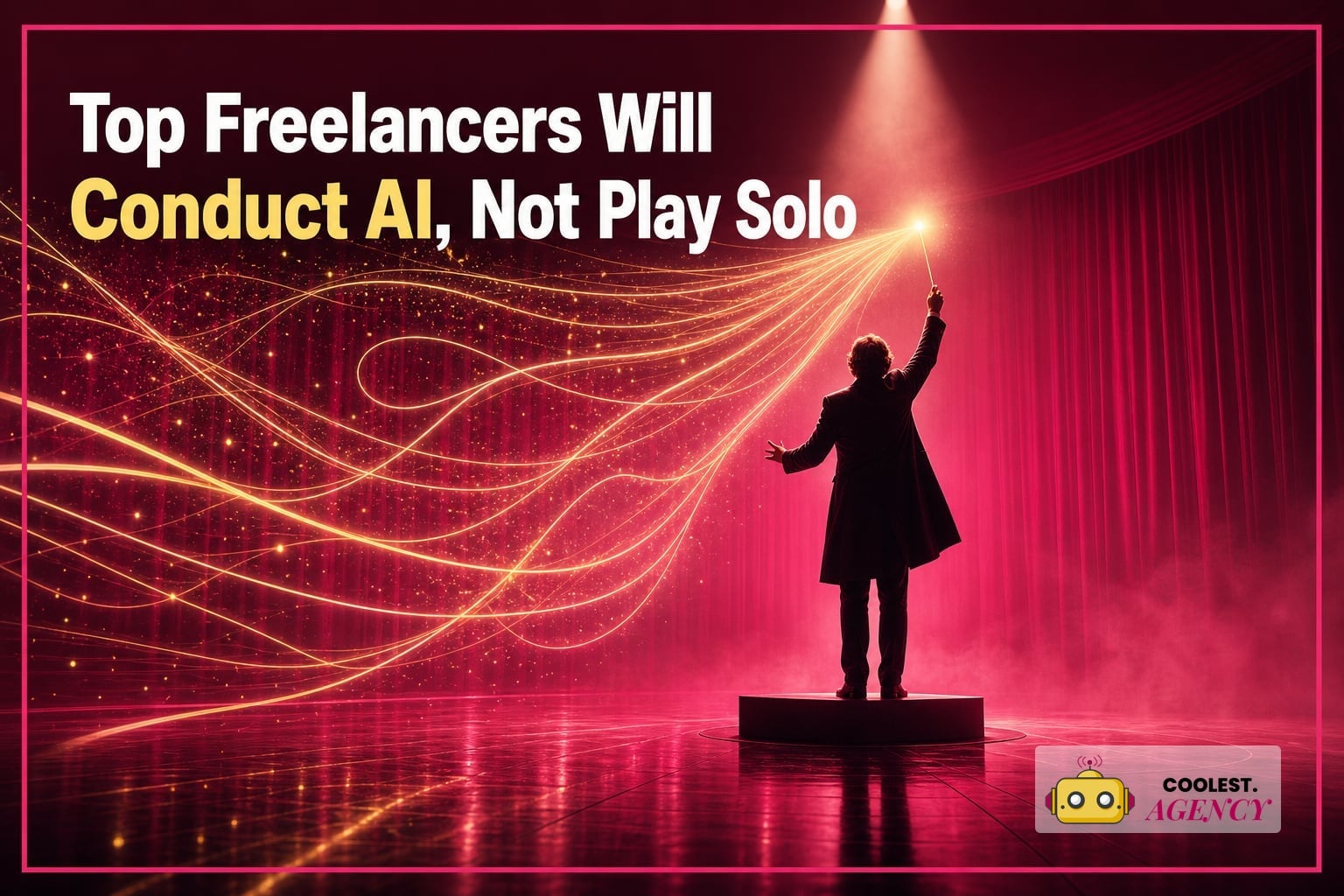
Why Tomorrow's Top Freelancers Will Conduct AI Instead of Playing Solo
The AI freelancing future pays the person who directs the instruments, not the one who plays fastest. Everyone owns the same model now. I think the premium belongs to the conductor: one creative, five-person output, work that still sounds human.
Key Takeaways
- Conductors earn the premium: AI-enabled freelancers make roughly 40% more per hour, but only when direction, not speed, is what they sell.
- Competent output is now free, so hours worked no longer predicts price.
- Four moves turn one person into a team: brief, direct, edit, sign off.
- Taste, narrative nerve and ethical judgment cannot be averaged into existence by a model.
Why Does the Soloist Model Hit a Ceiling in 2026?
The soloist model caps out because AI made competent output free. When every freelancer can draft in seconds, hours worked stops predicting price and clients pay for direction.
Look at the adoption curve. Digital Applied's 2026 roundup puts generative AI use among independents at 74%, up from 65% in 2024. Owning the instrument is no longer a signal. It is table stakes.
The damage lands on pure execution. Writing job postings fell over 21% and image-creation roles fell 17%. If you sell drafts by the hour, you are selling the one thing that just got cheap.
Here is the contrast I keep seeing. The soloist plays one chair faster each year and hits a wall at 40 billable hours. The conductor stops playing and starts shaping the whole sound. Same week, same model, a different price tag. You already feel this ceiling. It is not about effort.
How Do You Do Freelancing With AI as a Conductor?
Conducting means you brief, direct, edit and sign off. AI plays the sections, you own the interpretation, so one person ships a five-person team's output without the generic sound.
Picture a Tuesday. A logistics client needs a month of content. The soloist opens a blank prompt and accepts whatever returns. The conductor does four things instead.
- Brief: hand the model a point of view, an audience and a forbidden-phrases list before it writes a word.
- Direct: assign sections one at a time (headline, hook, proof), the way a Grandmaster plans three moves ahead. Logistics becomes Swiss Watch precision, not "streamlined solutions."
- Edit: cut every sentence a competitor could have published.
- Sign off: put your name on it, and take the risk that comes with the name.