← Back to blog

7 Proven Strategies to Overcome Content Fatigue and Scale Your Freelance Business

E

· 25 May 2026 · 6 min read

7 Proven Strategies to Overcome Content Fatigue and Scale Your Freelance Business

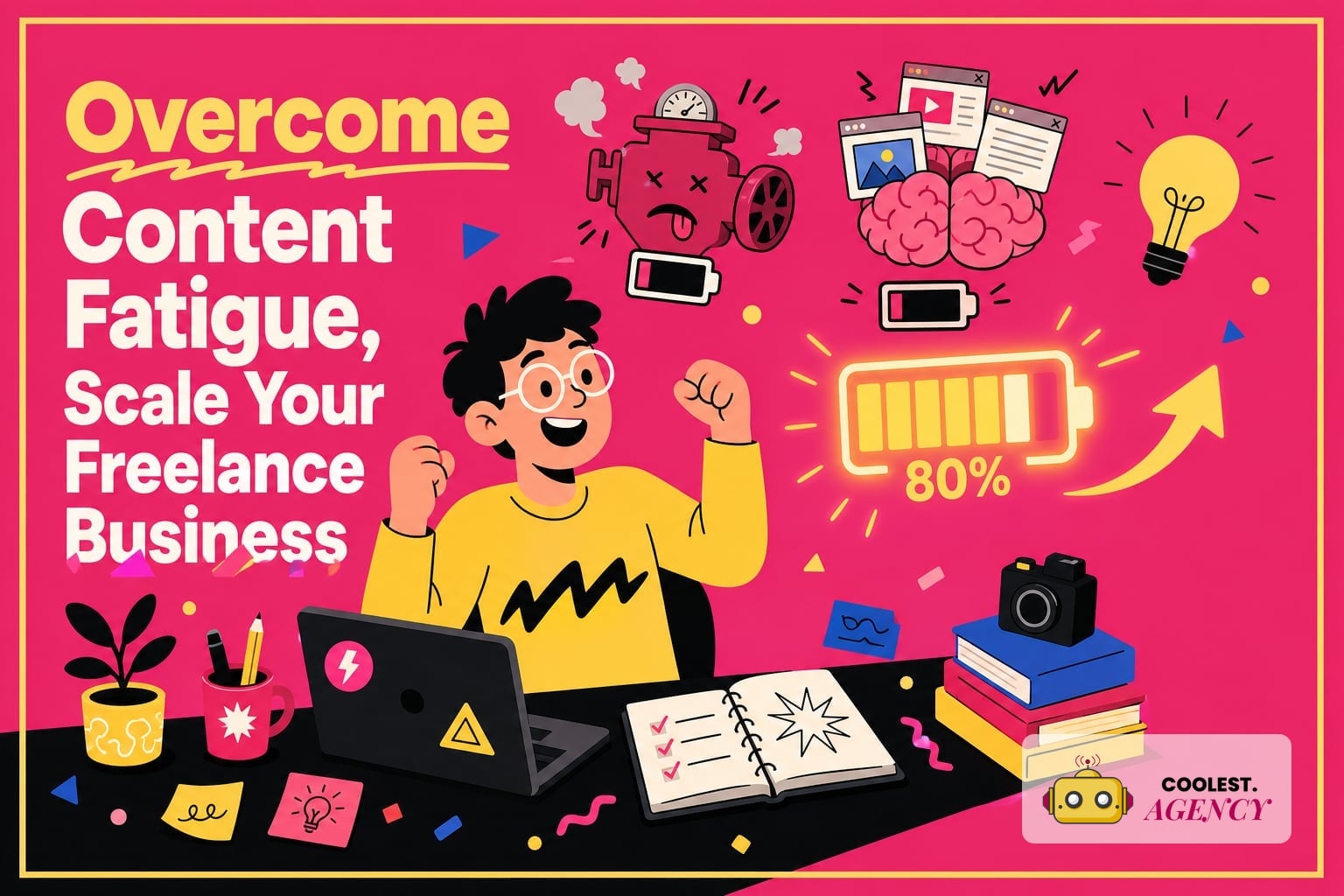
Overcoming Content Fatigue: 7 Proven Strategies to Scale Your Freelance Business

Overcoming content fatigue is not about posting less or taking a vacation. It is about redesigning how your creative energy flows through your business. Freelancers who scale past the 5-client ceiling do one thing differently: they stop treating output as the goal and start treating energy as the asset. Here is exactly how they do it.

Key Takeaways: How to Overcome Content Fatigue and Scale as a Freelancer

  • Content fatigue and burnout are different problems that need different fixes.
  • Creative energy is a finite resource. Manage it like money, not time.
  • Systems beat willpower every single time.
  • Scaling without structure just means burning out faster at a higher income.
  • The 7 strategies below work cumulatively. Do not cherry-pick.

What Causes Content Fatigue for Freelancers and Why It Is Different Than Burnout?

Content fatigue is the specific creative exhaustion that comes from producing high-volume output on repeat, not from working too many hours in general. It hits differently than burnout because the source is cognitive overload from idea generation, not just workload.

Burnout is a full-system crash. Content fatigue is more like a browser with 47 tabs open. You are technically running, but nothing loads properly. Research on freelancer burnout shows the warning signs include persistent anxiety, creative blocks, and the creeping sense that every brief looks identical.

Here is the part nobody talks about: the problem is not volume. It is context-switching. According to Everlance, mental blocks from shifting between tasks can cost up to 40% of your productive time. For a freelancer juggling five clients, that is nearly half your day gone before you write a single word.

A 2025 LinkedIn analysis found that 67% of marketing teams report having to deliver more results without extra resources. That pressure lands hardest on freelancers, who have no team to absorb the load.

The fix starts with correctly diagnosing which problem you actually have. Burnout needs rest. Content fatigue needs structure. Confuse the two and you will take a week off, come back refreshed, and hit the same wall by Thursday.

How Creative Energy Management Unlocks Scalable Growth

Creative energy management is the practice of scheduling your highest-cognitive work during your peak mental hours and protecting that time from administrative noise.

Most freelancers do the opposite. They answer emails at 9 AM, then wonder why their 2 PM writing session feels like pulling teeth. You are spending your best fuel on the lowest-value tasks.

Think of it this way: your creative capacity is a battery, not a tap. It does not refill just because you want it to. FreelancerMap's 2025 study found that reducing work time by 20% can actually maximize deep work intensity. Less time, more output. That is not a paradox; it is basic energy economics.

The scalable freelancers are not working harder. They are working in concentrated bursts on high-value creative work, then using systems to handle everything else. Coolest.Agency's approach to this is worth noting: it automates the social marketing plan and publishing layer entirely, so the creative brain never has to context-switch into scheduler mode. You set the plan over a coffee, then your attention stays on the work that actually pays.

Automate your entire content operation

Generate, publish, and track a month of posts on autopilot.

Start Free

The biggest mistake creative professionals make is treating their attention like it is renewable on demand. It is not. Peak creative output requires deliberate recovery cycles, not just longer hours.

Dr. Sandra Bond Chapman, Founder and Chief Director, Center for BrainHealth at The University of Texas at Dallas, speaking at the 2019 BrainHealth Summit

The practical move: audit your last five workdays. Note when you produced your sharpest ideas. Block that window permanently for creative work only. Guard it like a client deadline.

7 Proven Strategies for Overcoming Content Fatigue and Scaling Your Freelance Business

These seven strategies are a system, not a menu. Each one builds on the last. Skip ahead and you are just rearranging deck chairs.

1. Batch by cognitive type, not by client

Group all research tasks together, all writing together, all editing together. Your brain shifts gears expensively. Stop making it do that every hour.

2. Kill the "conflicted yes"

Every project you accept reluctantly drains energy from the work you care about. The Slant Letter identifies the "conflicted yes" as one of the biggest drains on creative energy. Be selective. Selectivity is a scaling strategy.

3. Build a content skeleton library

Create 10 to 15 reusable structural templates for your most common deliverables. You are not recycling ideas. You are eliminating the blank-page tax on every project.

4. Productize one core offer

Productize and Scale argues this is the single most effective way to grow beyond the solo ceiling. A fixed-scope, fixed-price offer means no custom scoping, no scope creep, and no creative energy spent on proposals.

5. Automate your distribution layer

Trade Press Services reports that 66% of buyers want fewer marketing messages. Quality distribution beats volume every time. Use tools that handle scheduling so your brain handles only creation. Coolest.Agency, for instance, learns your brand voice and stays aligned to it across every scheduled post, removing the mental load of brand-consistency checks.

6. Track one creative energy metric weekly

Column Content's fatigue metrics framework shows that declining engagement is a lagging indicator. The leading indicator is your own output quality score. Rate your work daily on a 1 to 5 scale. If you score below 3 for three days straight, something structural needs to change.

7. Schedule a weekly "dead hour"

One hour per week with zero deliverables. Read something outside your niche. Walk. Sketch. This is not self-care fluff. It is creative input. You cannot output ideas you never input. PNC Logos data shows that posting up to 35 times per week brings only a negligible 5% increase in website traffic. Volume is not the answer. Freshness is.

Your Next Move

Pick one strategy from the list above and implement it before Friday. Not all seven. One. Audit your calendar for your peak creative window, block it, and defend it for two weeks. That single change will do more for your output quality than any productivity app you have ever downloaded.

Ready to put your marketing on autopilot?

Join teams that ship more content in a week than most do in a month.

Get Started Free

Automate your content

Start Free