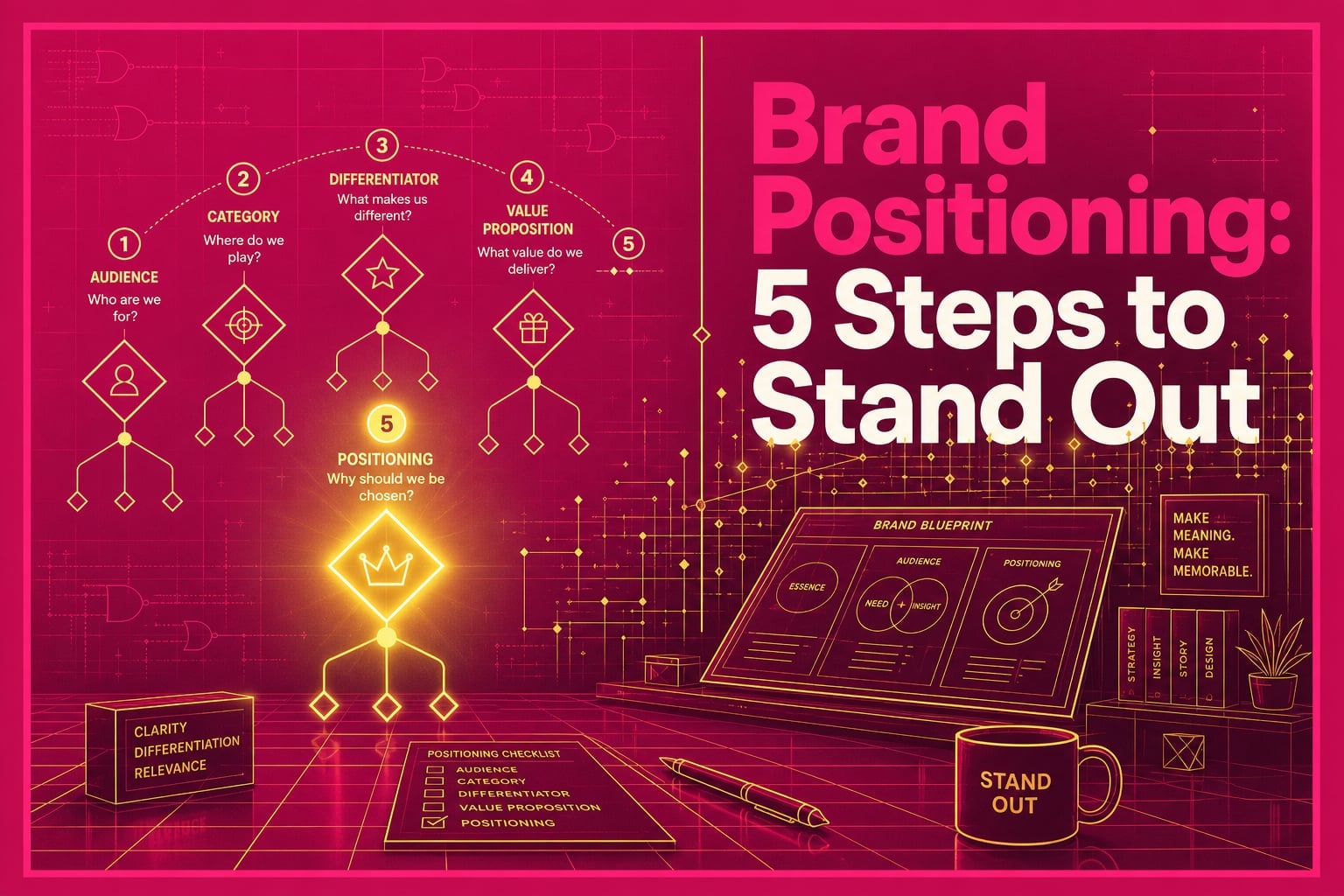
The 5 Brand Positioning Steps That Actually Work (Without the Generic Fluff)
Most brand positioning advice tells you to "find your why" and "know your audience." Groundbreaking. Here is what those articles skip: positioning is not a feeling exercise, it is an architecture problem. These 5 brand positioning steps treat it like one, using logic gates, forensic profiling, and AI-proof persona hardcoding to build a brand competitors cannot reverse-engineer.
Key Takeaways: What Are the 5 Brand Positioning Steps?
Brand positioning steps are the sequential decisions that define how your brand occupies a specific, defensible place in your audience's mind relative to competitors. Think of them less as a checklist and more as load-bearing walls. Remove one and the whole structure sags.
- Step 1: Audit your current position with brutal honesty
- Step 2: Architect values and vision using verbs, not adjectives
- Step 3: Hardcode your brand persona with logic gates
- Step 4: Run forensic audience profiling to turn data into differentiation
- Step 5: Write a positioning statement that actually excludes someone
According to Drive Research, 81 percent of consumers need to trust a brand before considering a purchase. You cannot build trust on a brand that looks like everyone else's.
Why Most Brand Positioning Advice Fails in the AI Era
Generic brand positioning strategy is the process of staking a claim in a market, but in 2025 that claim is being buried under a flood of AI-generated content that all sounds identical. The problem is not the tools. It is that most brands never built a real position to begin with.
A recent study found consumers would not care if 77 percent of 1,800 brands disappeared. That stat should make you uncomfortable. It means most brands are occupying space without earning it.
The brands that survive AI commoditization are the ones with a hardcoded identity: specific, opinionated, and impossible to average out.
How to Architect Your Unique Brand Values Using These Brand Positioning Steps (No Adjectives Allowed)
Brand values architecture is the process of translating abstract beliefs into concrete, behavioral commitments that guide every decision the brand makes. The rule here is simple: no adjectives. Adjectives are the enemy of positioning.
Say "innovative" and you mean nothing. Say "we ship a working prototype before the client finishes their second espresso" and now you have a position. Every value must answer: what do we actually do differently?
The brands that win on positioning are the ones that make a specific promise to a specific person and then keep it obsessively. Vague values are just expensive wallpaper.
Youngme Moon, Professor of Business Administration, Harvard Business School, speaking on brand differentiation in her book Different: Escaping the Competitive Herd
HubSpot's brand strategy breakdown notes that Morning Consult found 95 percent of tracked consumer brands hold lower trust ratings with Gen Z than with all U.S. adults. Gen Z reads vague values as red flags, not reassurance.
Hardcoding Your Brand Persona: Logic Gates, Not Vibes
A brand persona is a fictional but precise profile that defines exactly how your brand speaks, reacts, and decides across every channel and context. Most brands treat persona as a mood board. That is not a persona, that is a vibe. Vibes drift. Logic gates do not.