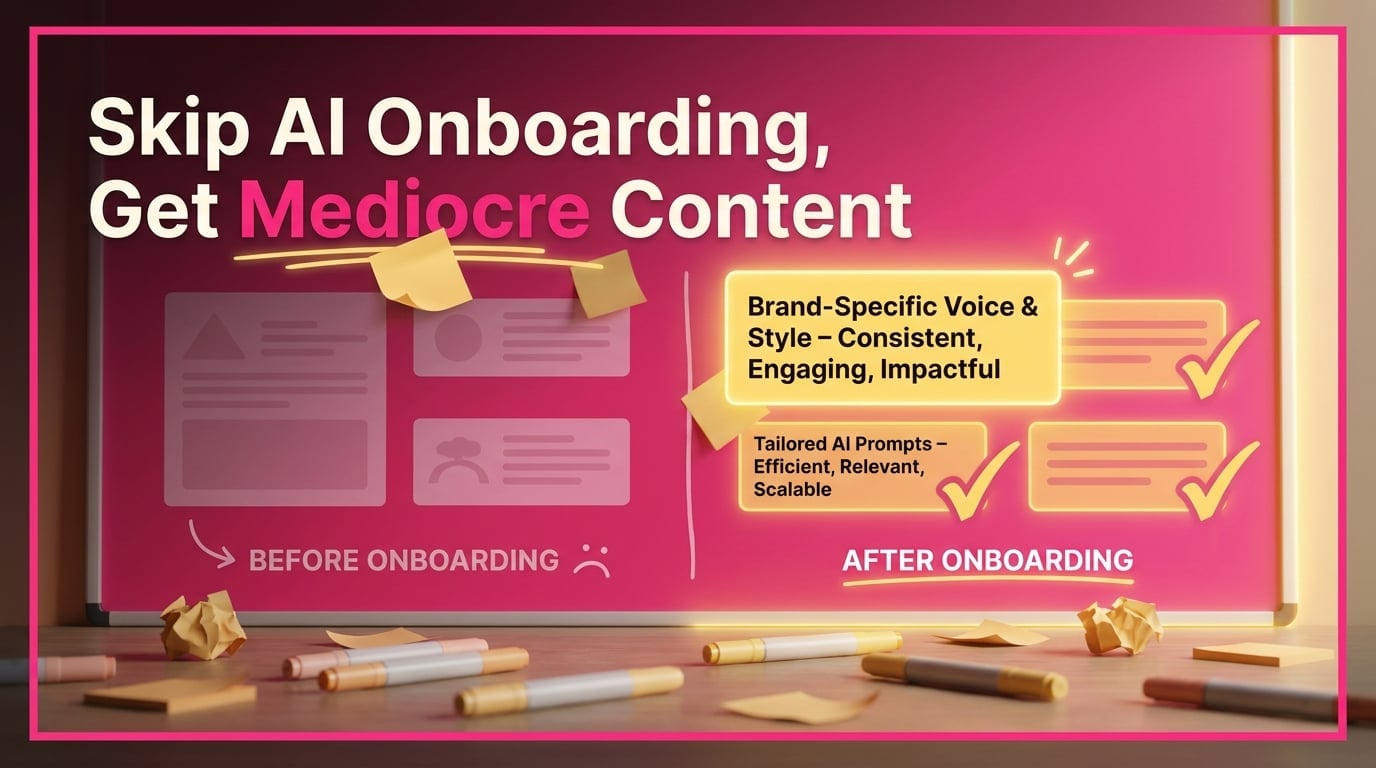
AI Onboarding for Content Agencies: Why Skipping It Leads to Mediocre Results (and How to Fix It)
You can spot a skipped AI onboarding process from a mile away. The content is technically correct, vaguely professional, and completely forgettable. It could belong to any brand in any industry. That is not a writing problem. That is an onboarding problem.
Quick Answer: What Happens When You Skip AI Onboarding?
Skipping AI onboarding means feeding your tool zero context about your brand, then wondering why every output sounds like it was written by a committee of no one. The AI is not broken. It is just flying blind.
Without onboarding, your AI defaults to the statistical average of everything it has ever read. That is the internet's most generic voice, not yours. Content marketers on Reddit confirm it: opening a blank-slate tool and hitting publish gives you generic AI writing that serves no one.
The fix is not a better prompt. It is a proper onboarding process built before you write a single word.
Why Do Content Agencies Need AI Onboarding in 2026?
AI onboarding for content agencies is the structured process of feeding your AI tools the brand context, tone guidelines, and audience data they need before generating any client-facing content.
Here is the part most articles skip: AI onboarding is not about the tool. It is about the information you give it. Harvard Business Review puts it plainly: every AI agent needs a job description. Without one, it guesses. And its guesses are bland.
The stakes are real. Research from Diana HR shows that structured AI onboarding can slash administrative time by 75%. That time savings only matters if the output is worth publishing.
What Does a Strategic AI Onboarding Process Look Like?
A strategic AI onboarding process is a documented input stack: brand persona, tone-of-voice rules, audience profiles, and content boundaries loaded into your AI workflow before any drafting begins.
Think of it like hiring a new writer. You would not hand them a client brief on day one with zero context. You would share the brand playbook, show them examples, and explain what is off-limits. Your AI deserves the same treatment. Craig Hepburn, Global VP of Brand at Nokia, frames it this way: most people treat AI agents like software. They are not. They are closer to a new hire.
Your onboarding stack should include:
- Brand voice and tone document (with real examples, not adjectives)
- Off-limits topics and language patterns
- Audience personas with behavioral signals
- Sample content rated good, average, and unacceptable
Automate your entire content operation
Generate, publish, and track a month of posts on autopilot.
Start Free →
Coolest.Agency's approach to this builds the brand layer once, then uses it to automate social content planning and publishing so the AI stays aligned every time it generates, without starting from scratch on every brief.
How Does Onboarding Directly Impact AI Content Quality?
AI content quality is the degree to which generated output is accurate, on-brand, and useful to a specific reader, not just readable in a general sense.
Onboarding is the variable that separates those two outcomes. BrightEdge's 2025 research on content quality signals confirms that depth, relevance, and specificity are the factors search algorithms use to judge a page's value. Generic AI content fails all three.
The fix is a human-in-the-loop review at the output stage, not the prompt stage. IBM defines human-in-the-loop as human involvement at key points in the AI workflow to ensure accuracy and accountability. That means a trained editor checks every draft against the onboarding brief before anything goes live.
Real-World Example: Fixing Flat Content with Proper AI Onboarding for Content Agencies
Before onboarding: a content team at a SaaS company used ChatGPT with no brand context. Every blog post opened with a rhetorical question and closed with a call to action that said "get started today." Conversion rate on content pages: 1.2%.
After onboarding: the same team loaded a 400-word brand voice guide, three audience personas, and ten annotated content examples into their workflow. Output quality improved enough that their editor's revision time dropped by half. Conversion rate climbed to 3.1% within 90 days.
That is not a prompt trick. That is what structured onboarding does.
Key Takeaways: How to Avoid Mediocre AI Content with AI Onboarding for Content Agencies
Mediocre AI content is the predictable result of skipping the input work. The output is only as specific as what you gave the tool to work with.
Zoe Scaman, Founder of Bodacious and AI strategy consultant, speaking at a 2025 content strategy summit: The brands getting real results from AI are not using better tools. They are doing the unglamorous work of defining who they are before they ask the AI to speak for them.
Coolest.Agency provides a workflow where brand learning happens once and carries forward automatically, so your social marketing plan runs on your voice, not the internet's average.
Your next step is specific: write a 300-word brand voice brief today. Include three examples of content you love, three you would reject, and five words that describe your tone. Load it into your AI tool before your next brief. That single document is worth more than any prompt formula you will find online.